

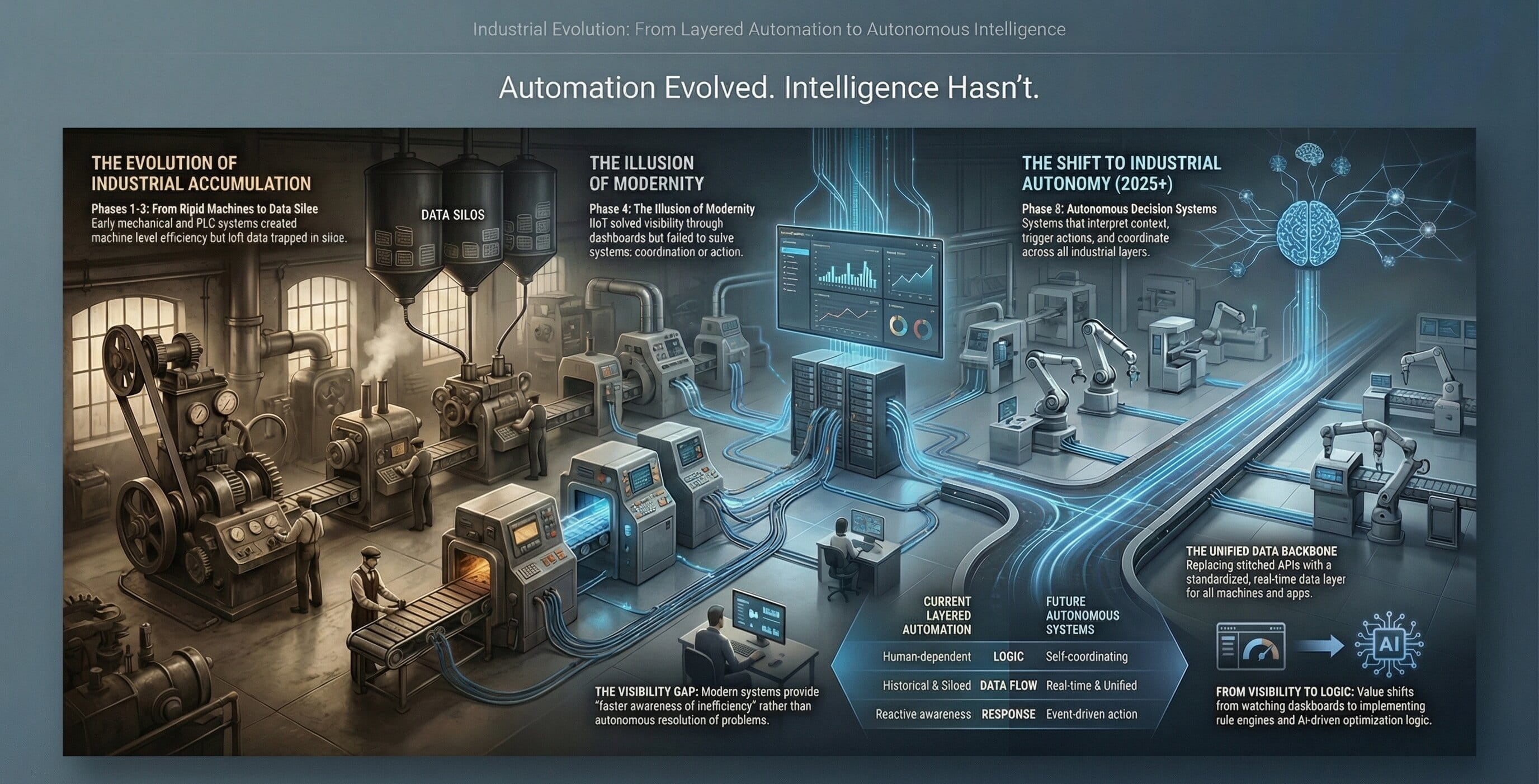
From Fixed Logic to Intelligent Systems
Industrial automation began with programmable logic controllers (PLCs) that executed fixed sequences. These systems were reliable but rigid, offering limited adaptability to dynamic production environments.
With the introduction of SCADA systems, industries gained visibility into operations. However, decision-making remained largely manual and reactive.
Architecture Evolution
The modern industrial architecture has evolved into a layered model:
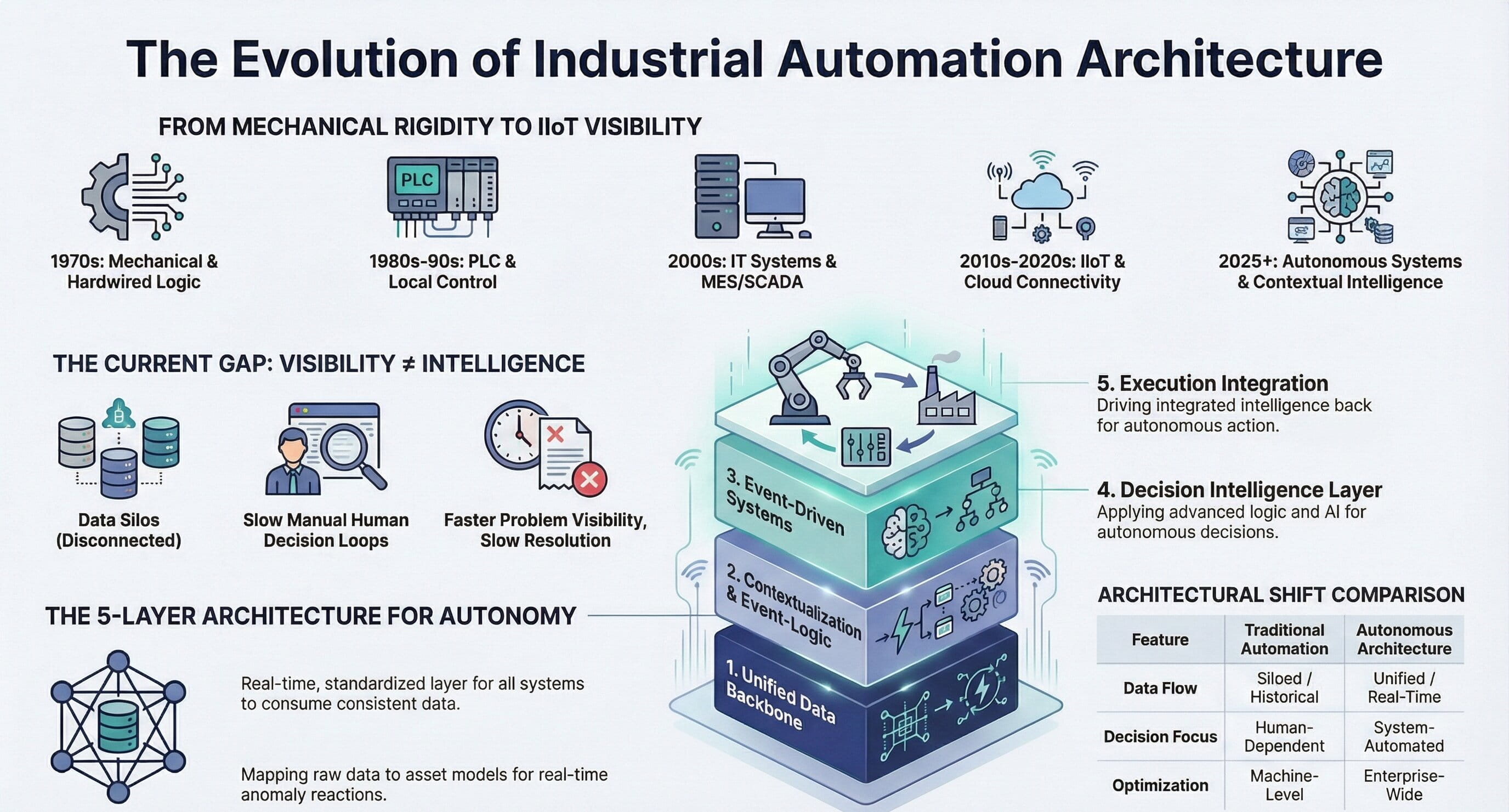
Edge Layer: Real-time data acquisition and preprocessing at machine level.
Platform Layer: Centralized data storage, analytics, and orchestration.
Enterprise Layer: Business integration, ERP, and strategic insights.
Industrial IoT and Data Platforms
The rise of Industrial IoT enabled continuous data streams from machines, enabling predictive maintenance and performance optimization.
Data platforms now unify disparate systems, enabling contextual analytics across production lines, shifts, and product batches.
ROI and Business Impact
Organizations adopting advanced automation architectures report:
- 30–50% reduction in downtime
- 20–30% increase in operational efficiency
- Significant improvements in product quality
Watch the Evolution
Listen to the Insights
The Future: Autonomous Factories
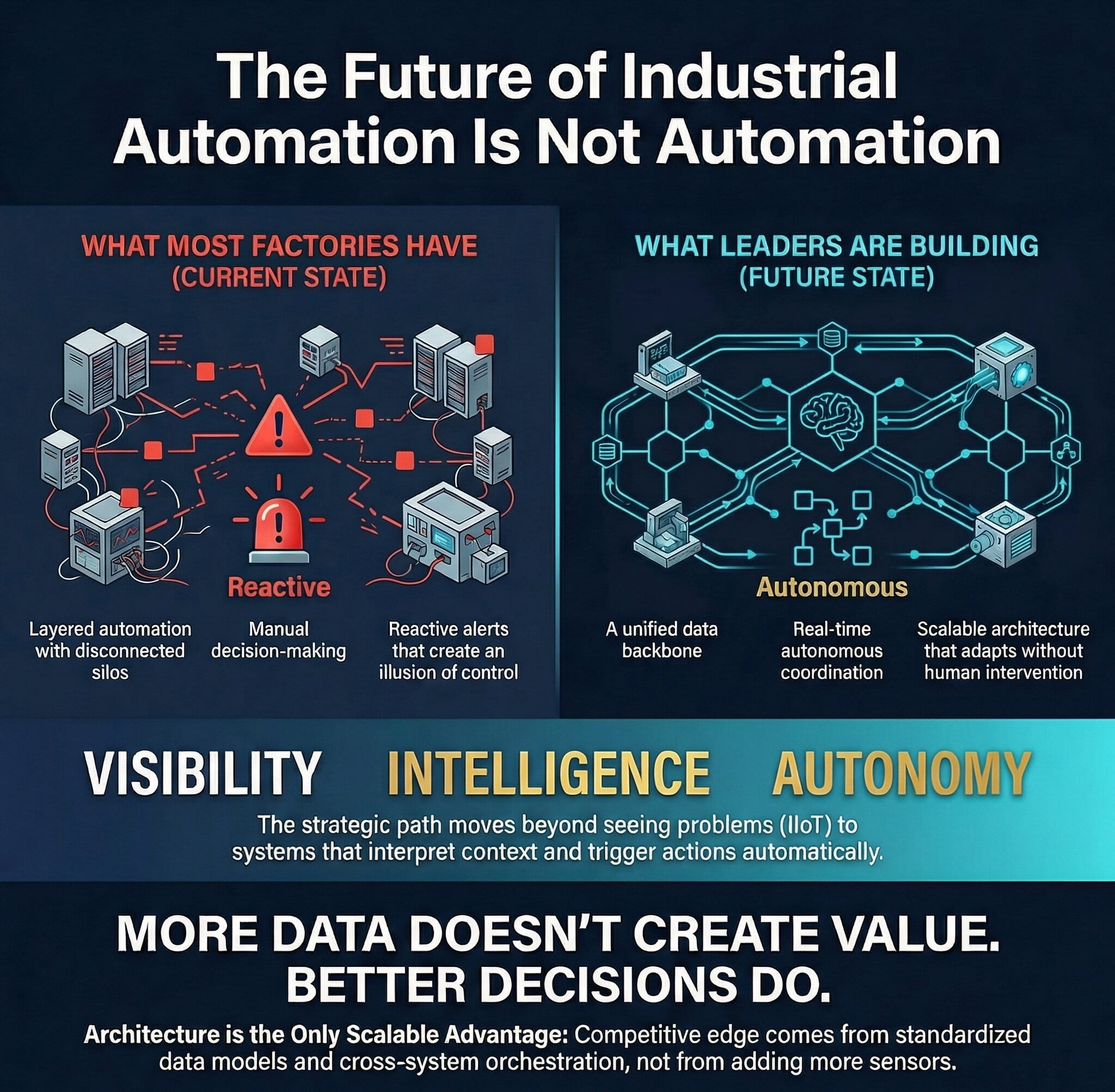
The next phase is autonomy—systems that self-optimize based on real-time conditions. AI-driven models will continuously learn and adapt without human intervention.
Implementation Roadmap
Successful transformation requires:
- Clear architecture strategy
- Incremental deployment
- Strong data governance
- Cross-functional alignment
Enhanced Full Blog Text — Board-Ready Report Format
Executive Summary
Industrial automation is undergoing a fundamental transformation. What began as rigid, rule-based systems has evolved into intelligent, adaptive ecosystems powered by data, connectivity, and artificial intelligence.
Evolution Phases
Phase 1: PLC-driven automation focused on deterministic control.
Phase 2: SCADA-enabled visibility with centralized monitoring.
Phase 3: IoT integration enabling real-time data streams.
Phase 4: AI-driven predictive and autonomous systems.
Architecture Transformation
Modern architectures decouple operational layers, allowing scalability and flexibility. Edge computing ensures low-latency processing, while centralized platforms provide advanced analytics.
Strategic Insights
Key insight: Data without context delivers limited value. Integrating production, maintenance, and business data is essential.
Organizations that successfully implement unified data platforms outperform peers in efficiency and resilience.
Business Impact
Operational efficiency improves significantly, with measurable reductions in downtime and cost.
Future Outlook
The transition toward autonomous factories is inevitable. Enterprises must invest in scalable architectures today to remain competitive.
Ankit updated on 19 Nov 2024, 10:15AM
This breakdown of automation maturity is extremely practical. We’re currently between SCADA and IoT layers and struggling with integration gaps.Jonas updated on 19 Nov 2024, 12:05PM
Same here. The biggest issue for us is contextualizing machine data with production orders. Without that, analytics feels disconnected.Priya updated on 20 Nov 2024, 08:30AM
The shift from reactive to predictive systems is where real ROI lies. We saw downtime reduction once we integrated edge analytics.Markus updated on 21 Nov 2024, 02:10PM
The architecture diagram clarified a lot. Especially the separation between edge, platform, and enterprise layers—this is often misunderstood internally.Elena updated on 21 Nov 2024, 03:45PM
Yes, and governance becomes much easier once responsibilities are split across layers instead of a monolithic system.Ravi updated on 22 Nov 2024, 11:20AM
Interesting point on autonomous factories. But realistically, how many companies are actually achieving that level today?Thomas updated on 22 Nov 2024, 01:05PM
Very few. But the roadmap matters more than the destination. Incremental autonomy—like self-adjusting processes—is already happening.Sophie updated on 23 Nov 2024, 09:55AM
The inclusion of audio/video is great. Makes it easier to consume depending on time constraints.Arjun updated on 24 Nov 2024, 04:25PM
Would love a follow-up on implementation cost models and ROI benchmarks across industries.