

Executive insight: The manufacturers getting real value from Industrial IoT are not the ones collecting the most data. They are the ones that connect a focused business problem, a scalable OT-aware architecture, clean contextualized data, secure deployment, and frontline action loops into one operating model.
Why So Many Industrial IoT Projects Still Fail
For more than a decade, manufacturers have been promised a revolution. Sensors would transform machines into data sources. Dashboards would reveal hidden inefficiencies. AI would optimize operations. And yet many factories still struggle to move beyond pilot projects.
Across Europe, the United States, and Asia, manufacturers have experimented heavily with Industrial IoT, but relatively few have scaled it cleanly across multiple production lines or sites. The issue is rarely the technology itself. More often, the problem lies in how projects are framed, governed, integrated, and operationalized.
What goes wrong first
Programs often begin with a platform decision, a sensor discussion, or a broad “digital transformation” ambition before the business case is narrow enough to act on.
What breaks at scale
Pilot-stage tools, weak OT-IT alignment, poor data quality, and cloud-heavy designs become bottlenecks when the organization tries to expand across assets and sites.
What leaders do differently
High-performing smart factories sequence adoption around measurable problems, edge-aware architecture, secure integration, workforce trust, and ROI discipline.
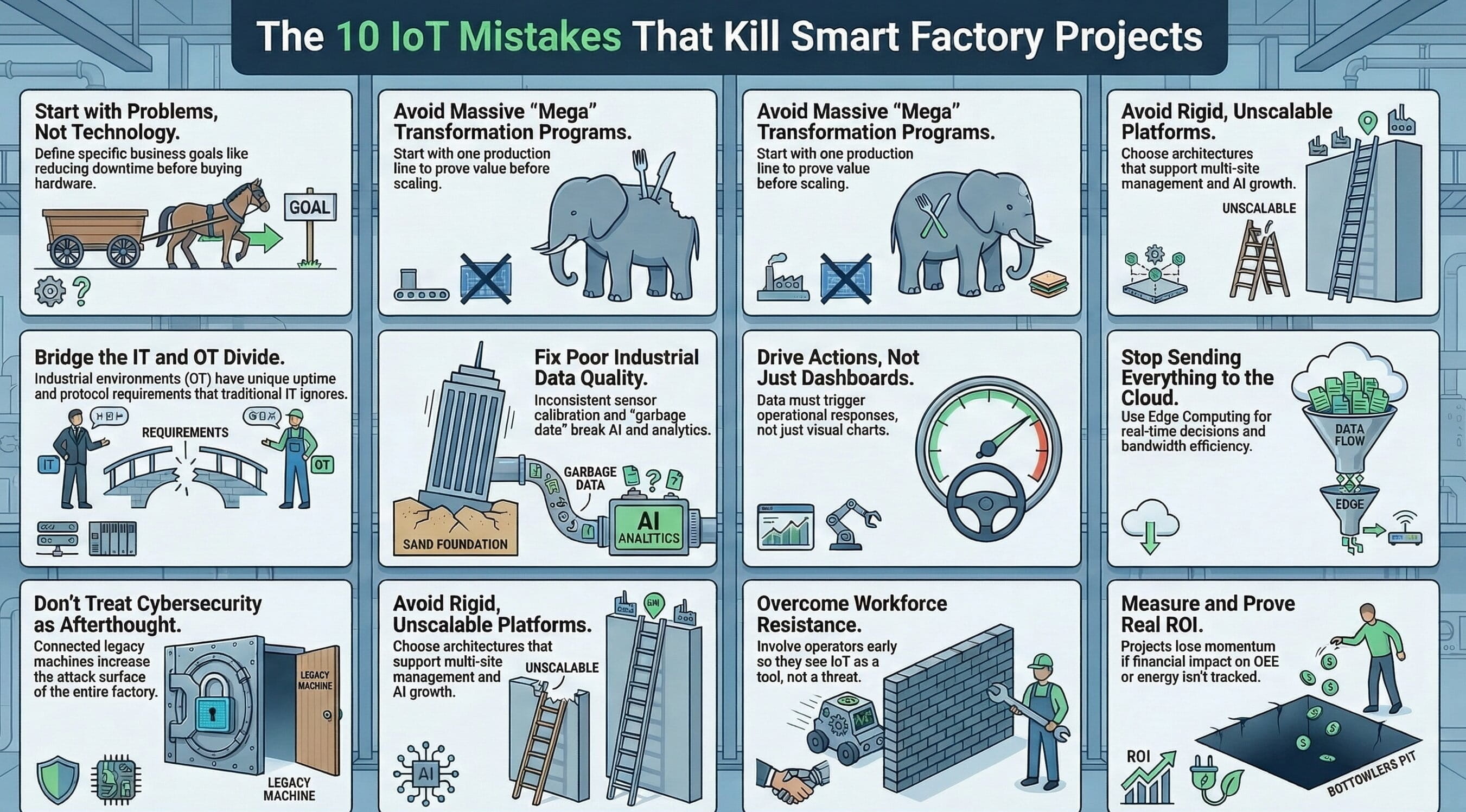
The 10 IoT Mistakes Manufacturers Make in 2026
Starting With Technology Instead of Business Problems
Many teams begin by asking which sensors to install or which IoT platform to buy. That is the wrong first move.
Successful manufacturers start with operational impact: reducing unplanned downtime, improving OEE, lowering energy costs, strengthening traceability, or reducing scrap and quality losses.
Smart factory response: Define one measurable operational problem first, then build the data and architecture stack around that use case.
Designing Massive Transformation Programs
Large multi-year IoT transformations often get buried under planning cycles, governance overhead, and delayed decision-making.
Meanwhile, plant inefficiencies continue untouched. The most effective manufacturers use a progressive scaling model: prove value in one line or machine group, then extend the pattern.
Smart factory response: Scale in waves, not through one oversized program plan.
Treating Industrial IoT Like a Traditional IT Project
Factories run on legacy PLCs, proprietary industrial protocols, strict uptime constraints, and harsh physical environments that do not behave like office IT.
Generic enterprise deployment approaches can disrupt production if applied without OT context.
Smart factory response: Build the program jointly between IT and OT from the start so architecture and rollout choices stay practical and production-safe.
Ignoring Data Quality
Missing values, bad timestamps, inconsistent calibration, duplicate streams, and poor tag labeling quietly undermine analytics and AI performance.
Without validation, unreliable raw data propagates into dashboards, models, and decisions.
Smart factory response: Treat data engineering as a core capability with validation, normalization, synchronization, and standards built in.
Believing Dashboards Equal Transformation
Visibility is useful, but visibility alone rarely changes plant performance.
If a dashboard does not trigger maintenance alerts, operator guidance, automated quality actions, predictive workflows, or dynamic production responses, improvement stalls.
Smart factory response: Convert insight into action loops that change what happens next on the shop floor.
Sending All Data to the Cloud
Cloud-only thinking increases bandwidth cost, latency, and infrastructure complexity in high-volume industrial environments.
Real-time decisions such as vibration anomaly detection, threshold monitoring, protocol translation, and aggregation often belong closer to the machine.
Smart factory response: Use edge computing to process locally and transmit only relevant data upstream.
Treating Cybersecurity as an Afterthought
Every connected device expands the attack surface, and many legacy industrial assets were never designed for modern connectivity.
Late-stage security retrofits are expensive and risky.
Smart factory response: Architect for encrypted communication, segmentation, role-based access, secure authentication, and continuous monitoring from day one.
Choosing Platforms That Cannot Scale
Pilot-friendly tools often lack the integration depth, multi-site control, workflow extensibility, analytics maturity, and AI support needed for broader deployment.
That creates a painful replacement cycle later.
Smart factory response: Select platforms and architecture patterns that can grow with operational complexity and geographic scale.
Ignoring the Human Factor
Technology does not transform factories on its own. Operators, engineers, and maintenance teams determine whether the system becomes trusted and used.
When tools feel intrusive or disconnected from real work, resistance rises quickly.
Smart factory response: Involve frontline teams early, incorporate their machine knowledge, and show how the system improves safety and daily execution.
Failing to Measure Real ROI
Without agreed metrics, leadership sees activity rather than business value, and momentum fades.
Downtime reduction, OEE improvement, energy savings, scrap reduction, and maintenance cost reduction should be defined before implementation begins.
Smart factory response: Tie every rollout phase to measurable outcomes that finance, operations, and plant leadership all recognize.
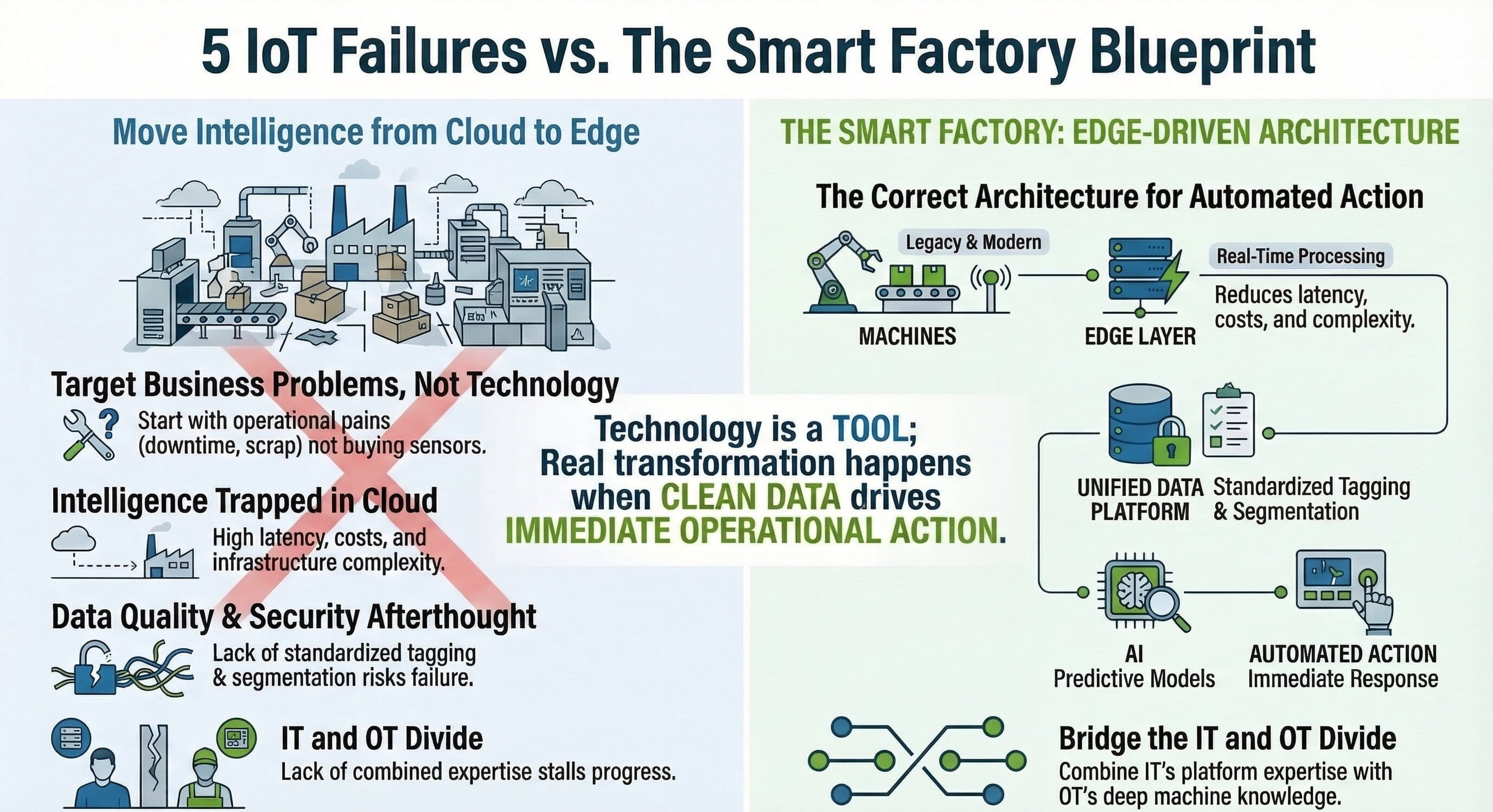
Architecture Framework Smart Factories Use Instead
The manufacturers that scale Industrial IoT successfully share a common pattern: they align the use case, the OT environment, the data pipeline, the security model, and the operating workflow before they try to industrialize the program across sites.
Target One Operational Constraint
Focus on a single high-value problem such as downtime, scrap, traceability, or energy waste.
Connect OT and IT Early
Design integration, governance, and rollout decisions jointly with controls, maintenance, cybersecurity, and platform teams.
Process at the Edge
Handle local event logic, anomaly detection, filtering, and protocol translation close to the machine.
Standardize the Data Layer
Normalize tags, synchronize timestamps, validate inputs, and create reusable context models.
Operationalize Insights
Turn analytics into work orders, alerts, operator guidance, and continuous improvement decisions.
ROI Model: What Executives Should Measure
Even modest operational gains can create significant financial impact when applied across production. The strongest IoT programs avoid vague innovation narratives and quantify improvement at the plant level.
Implementation Sequence for Manufacturers
| Phase | Priority Question | What Good Looks Like |
|---|---|---|
| Use Case Definition | What measurable operational problem are we solving first? | Clear KPI ownership, baseline metrics, and economic rationale. |
| OT/IT Integration | Can the architecture work safely in the real production environment? | Machine connectivity, protocol handling, change windows, and responsibilities are aligned. |
| Data Foundation | Can we trust the data enough to automate decisions? | Validation, time sync, normalization, and contextual tagging are in place. |
| Action Layer | How will insights change plant behavior? | Alerts, workflows, interventions, and guidance connect directly to operations. |
| Scale-Up | Can the same model extend across lines and sites? | Reusable templates, secure multi-site governance, and scalable platform choices. |
Explainer Video: The Pilot Trap
Explainer Audio: The Pilot Trap
“The future of Industrial IoT belongs to manufacturers that stop treating data as a reporting by-product and start using it as an execution system for continuous operational improvement.”
What Successful Smart Factories Do Differently
Manufacturers that scale Industrial IoT effectively do not chase technology for its own sake. They start with a focused operational problem, build an architecture that combines edge processing, data platforms, and advanced analytics, and prioritize cybersecurity and data quality from the beginning.
Most importantly, they connect insights to action. In these environments, data does not simply describe what happened. It helps determine what should happen next.
That is the real dividing line between another abandoned pilot and a smart factory program that compounds value over time.
Navigate This Blog
Enhanced Full Blog Text — Board-Ready Report Format
10 IoT Mistakes Manufacturers Make in 2026 — and How Smart Factories Avoid Them
Executive summary: For more than a decade, manufacturers have been promised that sensors, dashboards, and AI would transform operations. Yet many Industrial IoT programs still stall before enterprise scale. The root cause is rarely the technology itself. More often, failure emerges from weak problem framing, oversized rollout ambition, poor OT alignment, unreliable data, cloud-heavy design, delayed cybersecurity, non-scalable platforms, low workforce adoption, and unclear ROI discipline. The manufacturers that succeed take a fundamentally different route: they begin with operational value, design for scale early, and ensure that data drives action rather than passive visibility.
Why So Many Industrial IoT Projects Still Fail
For more than a decade, manufacturers have been promised a revolution.
Sensors would transform machines into data sources.
Dashboards would reveal hidden inefficiencies.
AI would optimize operations.
And yet, many factories still struggle to move beyond pilot projects.
Across Europe, the United States, and Asia, thousands of manufacturers have experimented with Industrial IoT. But surprisingly few have scaled it successfully across multiple production lines or sites.
The issue is rarely technology.
The real problem is how IoT projects are designed, executed, and integrated into operations.
Factories that succeed approach digital transformation very differently from those that fail.
After studying dozens of implementations across industries—from automotive suppliers to aerospace and heavy manufacturing—ten common mistakes appear repeatedly.
Understanding these pitfalls can mean the difference between another abandoned pilot project and a true smart factory transformation.
Mistake 1
Starting With Technology Instead of Business Problems
One of the most common mistakes is beginning with the wrong question.
Many teams start with:
“What sensors should we install?”
“What IoT platform should we buy?”
But the right starting point is always operational impact.
Factories that succeed define their projects around specific business problems, such as:
reducing unplanned downtime
improving overall equipment effectiveness (OEE)
reducing energy costs
improving traceability
reducing scrap and quality losses
Technology is only a tool.
If the problem is not clearly defined, the result is usually a sophisticated system that generates data but delivers little operational value.
The best projects start small with one measurable operational problem and build from there.
Mistake 2
Designing Massive Transformation Programs
Many organizations attempt to implement IoT as a large, multi-year digital transformation program.
The intention is good, but the outcome is often predictable.
Large programs create:
long planning cycles
slow decision processes
complex governance
high risk
Meanwhile, the factory floor continues to operate with the same inefficiencies.
Successful companies instead adopt a progressive scaling model.
They begin with a focused implementation on a single production line or machine group. Once value is demonstrated, the architecture is extended to additional areas.
This approach delivers early wins and builds organizational confidence.
It also allows the architecture to evolve based on real operational feedback rather than theoretical designs.
Mistake 3
Treating Industrial IoT Like Traditional IT Projects
Industrial environments are fundamentally different from office IT systems.
Factories operate with:
legacy PLCs and controllers
proprietary industrial protocols
harsh physical conditions
strict uptime requirements
Traditional IT deployment methods often fail in these environments.
For example, updating software in an office system might be routine. In a factory, a poorly timed update can disrupt production.
Successful IoT initiatives require close collaboration between IT and OT (Operational Technology) teams.
OT engineers understand machines and processes.
IT teams bring expertise in data platforms, cybersecurity, and integration.
When these teams work together from the beginning, architectures become more robust and practical.
Mistake 4
Ignoring Data Quality
Data quality is one of the least discussed but most critical aspects of industrial IoT.
Factories often discover that raw machine data is inconsistent or unreliable.
Common issues include:
missing values
incorrect timestamps
inconsistent sensor calibration
duplicated data streams
poorly labeled tags
Without proper validation, these issues propagate into dashboards and analytics systems.
Artificial intelligence models built on unreliable data produce unreliable results.
Successful smart factories treat data engineering as a core capability, implementing:
data validation layers
timestamp synchronization
standardized tagging
filtering and normalization
Clean data is the foundation for everything else.
Mistake 5
Believing Dashboards Equal Transformation
Dashboards are useful, but they rarely change operations by themselves.
Many factories deploy sophisticated visualization tools showing machine performance, energy consumption, or production metrics.
But if those insights do not lead to actions, nothing improves.
Real transformation occurs when data drives operational responses.
Examples include:
automatic maintenance alerts
operator guidance during anomalies
automated quality checks
predictive maintenance workflows
dynamic production adjustments
The goal is not simply to observe operations.
The goal is to improve them continuously.
Mistake 6
Sending All Data to the Cloud
In the early days of IoT, many architectures assumed that all data would be transmitted to cloud systems for processing.
This approach often creates several problems.
Industrial environments generate enormous volumes of data. Sending everything to the cloud increases:
bandwidth costs
latency
infrastructure complexity
Modern smart factories rely heavily on edge computing.
Edge systems perform processing close to machines, enabling real-time decisions such as:
vibration anomaly detection
threshold monitoring
protocol translation
data aggregation
Only relevant data is transmitted to central systems.
This approach improves responsiveness and reduces infrastructure costs.
Mistake 7
Treating Cybersecurity as an Afterthought
Every connected device increases the potential attack surface of a factory network.
Unfortunately, cybersecurity is often addressed late in IoT projects.
Industrial systems frequently contain legacy devices that were never designed for network connectivity.
Connecting these systems without proper safeguards can expose critical infrastructure.
Modern smart factory architectures implement security principles from the start, including:
encrypted device communication
network segmentation
role-based access control
secure device authentication
continuous monitoring
Cybersecurity is not optional in connected factories.
It is an essential design principle.
Mistake 8
Choosing Platforms That Cannot Scale
Many early IoT deployments rely on tools designed for small experiments.
These tools may work well for a pilot but become limiting when the organization attempts to scale.
Common limitations include:
poor integration capabilities
lack of multi-site management
limited automation workflows
restricted analytics capabilities
weak support for AI models
Replacing platforms later can be costly and disruptive.
Successful companies choose architectures designed for scalability from the beginning, ensuring that systems can grow alongside operational needs.
Mistake 9
Ignoring the Human Factor
Technology alone does not transform factories.
Operators, engineers, and maintenance teams play a critical role in adoption.
If the workforce perceives IoT systems as intrusive or threatening, resistance can emerge.
Successful organizations involve operational teams early in the design process.
Operators often provide valuable insights into machine behavior that data alone cannot reveal.
Training and transparency also help build trust.
When employees see how technology makes their work easier and safer, adoption increases dramatically.
Mistake 10
Failing to Measure Real ROI
Many digital transformation initiatives struggle because their financial impact is unclear.
If leadership cannot see measurable benefits, projects lose momentum.
Effective IoT initiatives define success metrics before implementation begins.
These metrics may include:
reduction in unplanned downtime
improvements in OEE
energy savings
reduced scrap rates
maintenance cost reductions
Even small improvements can produce substantial financial returns when applied across production operations.
Clear metrics ensure that IoT investments remain aligned with business outcomes.
What Successful Smart Factories Do Differently
Manufacturers that successfully scale Industrial IoT share several common practices.
They begin with focused operational problems rather than technology experiments.
They build architectures that combine edge computing, data platforms, and advanced analytics.
They prioritize data quality and cybersecurity from the beginning.
And most importantly, they connect data insights to operational decisions.
In these environments, data does not simply describe what happened.
It helps determine what should happen next.
The Future of Industrial IoT
As factories become increasingly connected, the role of data will continue to evolve.
The next stage of smart manufacturing will move beyond dashboards and static analytics toward systems capable of continuous optimization.
In these environments:
machines generate real-time operational data
edge systems analyze conditions instantly
centralized platforms coordinate insights across facilities
intelligent systems recommend or execute actions
The result is a manufacturing environment that becomes progressively more efficient, resilient, and adaptive.
But achieving that future requires avoiding the mistakes that have slowed adoption over the past decade.
Manufacturers that learn from these lessons today will be the ones leading the next wave of industrial innovation.
Arjun updated on 19 Feb 2026, 08:35AM
The point about starting with business problems instead of technology is exactly where many factory programs go wrong. We still see teams debating sensor density before they agree on whether downtime, scrap, or energy is the real target.Claire updated on 19 Feb 2026, 09:12AM
Agreed. In our plant, the first successful use case was not “digitize everything,” it was one bottleneck packaging cell with repeated micro-stops. Once that issue was quantified, adoption became much easier.Lukas updated on 19 Feb 2026, 11:05AM
Mistake 6 is especially relevant. Sending every signal to the cloud looked elegant on slides, but in production the latency and data volume made it unworkable. Edge filtering changed the economics for us.Neha updated on 19 Feb 2026, 12:41PM
Same experience here. We now process event detection locally and only move contextualized data upstream. That reduced both noise and infrastructure cost.Martin updated on 20 Feb 2026, 07:50AM
The article captures a pattern we see across multi-site manufacturers: dashboards get funded faster than workflows. Visibility improves, but frontline action does not. That gap is where transformation stalls.Sandeep updated on 20 Feb 2026, 10:28AM
The OT-IT collaboration section deserves more attention. In brownfield environments, architecture decisions made without controls engineers usually create rework later.Johanna updated on 20 Feb 2026, 01:16PM
Absolutely. We had an early platform pilot that looked perfect from an IT perspective, but it ignored maintenance windows and PLC constraints. OT involvement fixed the program, not the software vendor.Benjamin updated on 21 Feb 2026, 09:02AM
Data quality is still underappreciated at board level. Leaders ask why AI is not delivering, but the timestamp drift, duplicate tags, and labeling inconsistencies are usually the real issue.Kavya updated on 21 Feb 2026, 10:11AM
Well said. Once we introduced validation and tag standards, even basic analytics became more credible to production managers.Elena updated on 21 Feb 2026, 03:44PM
What stood out to me is the emphasis on measurable ROI. Too many digital initiatives rely on narrative momentum instead of agreed success metrics tied to OEE, downtime, and maintenance cost.Tobias updated on 22 Feb 2026, 08:20AM
The human factor section is practical. Operators will support digital tools when the system clearly reduces troubleshooting time or improves safety. If the rollout feels like surveillance, trust disappears immediately.Priyank updated on 22 Feb 2026, 09:03AM
That has been our learning too. Training plus visible problem-solving wins mattered more than the UI polish.Hannah updated on 22 Feb 2026, 02:18PM
A useful framework overall. The strongest takeaway for me is that scalable Industrial IoT is less about buying a platform and more about designing an operating model that links data, decisions, and accountability.