

Manufacturing leaders have spent years investing in sensors, dashboards, and analytics platforms, yet many plants still depend on operators, engineers, and maintenance teams to interpret signals and make the final call. That is not a contradiction. It is a design reality. The modern factory is a socio-technical environment where machine data, operational context, and human experience must work together if digital transformation is meant to improve outcomes rather than simply increase data volume.
The next step is not the removal of people from operations. It is the design of human-centric AI systems that explain, recommend, investigate, and support action while keeping decision authority where it matters most. When that collaborative AI model is connected to agentic systems and a contextual plant-wide data backbone such as the Unified Namespace, factories move from passive visibility to intelligent decision ecosystems.
Audio Brief
Prefer an executive listen-through instead of reading the full article first? Use the audio version below.
Video Brief
Need a faster visual overview for leadership, program sponsors, or cross-functional teams? Use the video briefing below.
Why today’s smart factories still struggle to decide
Data overload is not intelligence
Many factories have become excellent at collecting signals and very poor at converting them into trusted action. Operators interpret machine behavior. Engineers correlate events across systems. Managers rely on experience instead of analytics when time pressure rises. This is the core failure mode of many Industry 4.0 programs: better visibility, but not materially better decision-making.
The three reasons traditional industrial AI adoption stalls
1. Black-box outputs
If a model recommends shutting down a high-value machine and cannot explain why, plant trust disappears immediately. Industrial decisions carry safety, quality, and revenue consequences. Opaque predictions do not scale on the shop floor.
2. Weak context
A machine signal means very little on its own. Schedules, maintenance history, environmental factors, operator behavior, and supply chain events change the meaning of the same pattern. AI without context often produces technically valid but operationally unusable outputs.
3. Human accountability never disappears
Even when AI assists, the action still sits with operators, engineers, supervisors, and plant managers. No serious manufacturer delegates major operational risk to an algorithm that cannot justify itself in plant language.
Human-centric AI: the model that fits real factories
What it is
Human-centric AI is not designed to eliminate human expertise. It is designed to amplify it. Instead of treating people as friction in the automation journey, it treats them as a required part of the intelligence loop.
- Explain the reasoning behind recommendations
- Recommend actions rather than issue blind commands
- Learn from human feedback and operating reality
- Support operators and engineers as an industrial co-pilot
Why it works
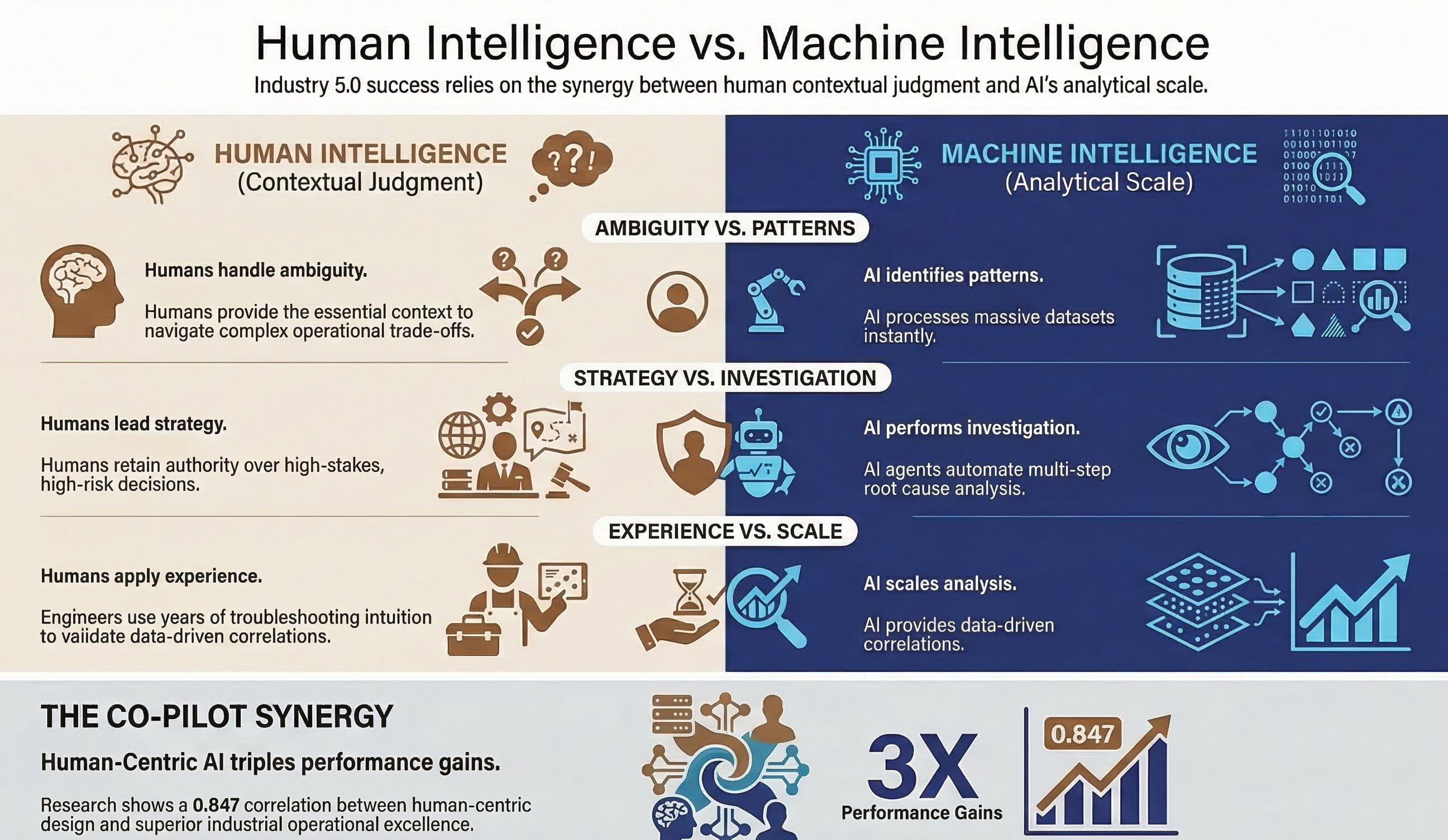
AI is excellent at scanning large datasets, pattern recognition, and surfacing non-obvious correlations. Humans remain stronger at contextual judgment, ambiguity handling, and balancing operational trade-offs. Put together, they form a more resilient decision system than either could create alone.
The future of industrial intelligence is not autonomous AI replacing people. It is explainable AI helping the right person make the right decision faster.
Why agentic systems matter now
Human-centric AI becomes much more powerful when factories add agentic AI capabilities. Agentic systems do not just flag anomalies. They investigate them. They can reason across multiple steps, pull evidence from different sources, and produce structured recommendations instead of generic alarms.
Detect
Identify a meaningful deviation in vibration, load, temperature, quality, or process behavior.
Investigate
Check historical records, similar equipment behavior, recent changeovers, and environmental shifts.
Reason
Form a likely root-cause pathway and rank corrective options with clear confidence and assumptions.
Support action
Present a human-readable recommendation for approval, escalation, or controlled automation.
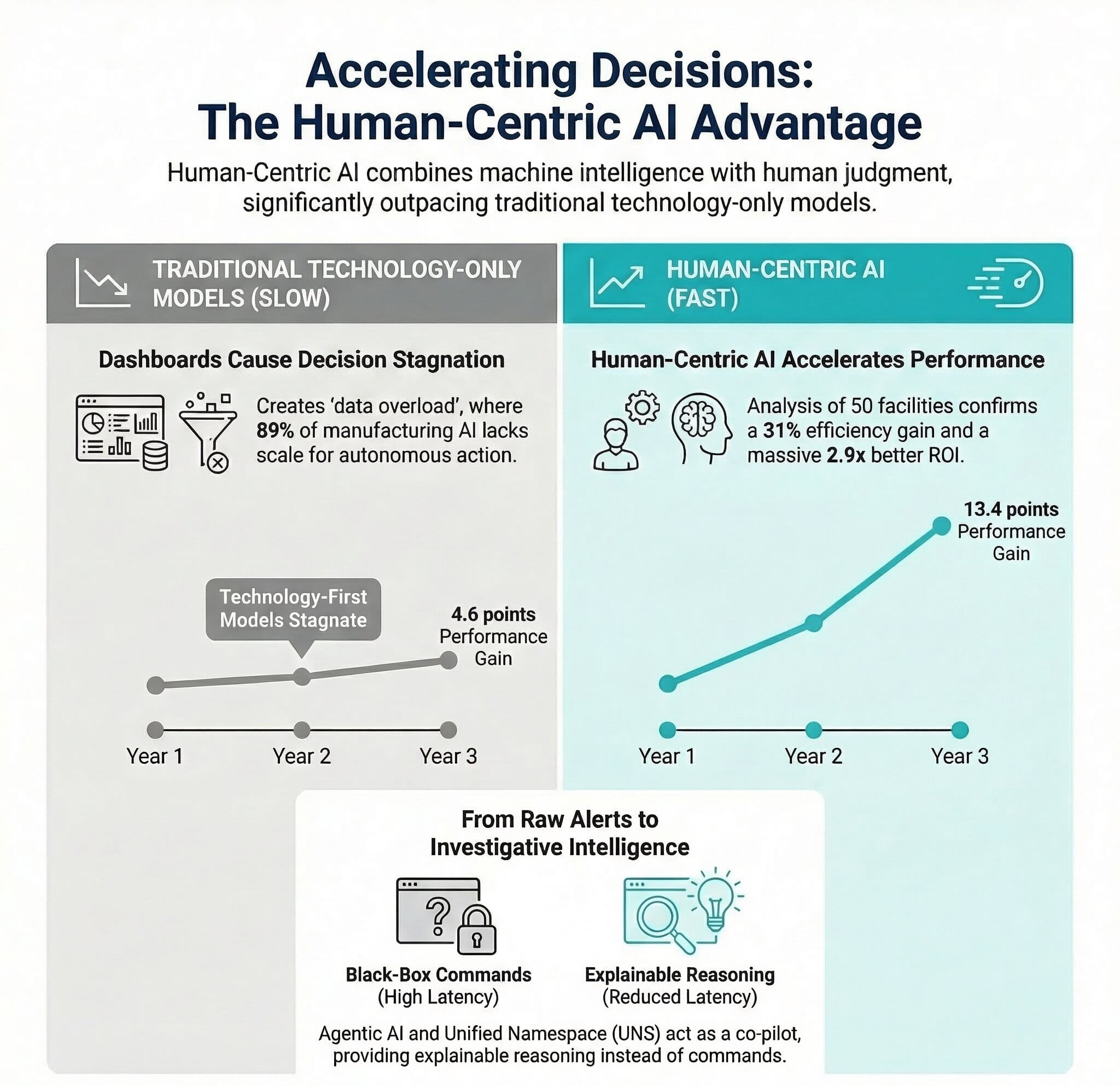
The plant stops receiving disconnected alerts and starts receiving contextual, evidence-backed guidance. That is the shift from analytics to investigative intelligence.
Architecture framework: from fragmented systems to a decision ecosystem
Agentic intelligence cannot operate well in a fragmented data landscape. Industrial data typically sits across PLCs, SCADA, MES, ERP, historians, maintenance systems, and local operator notes. The architecture problem is not simply access. It is context. This is where the Unified Namespace becomes foundational.
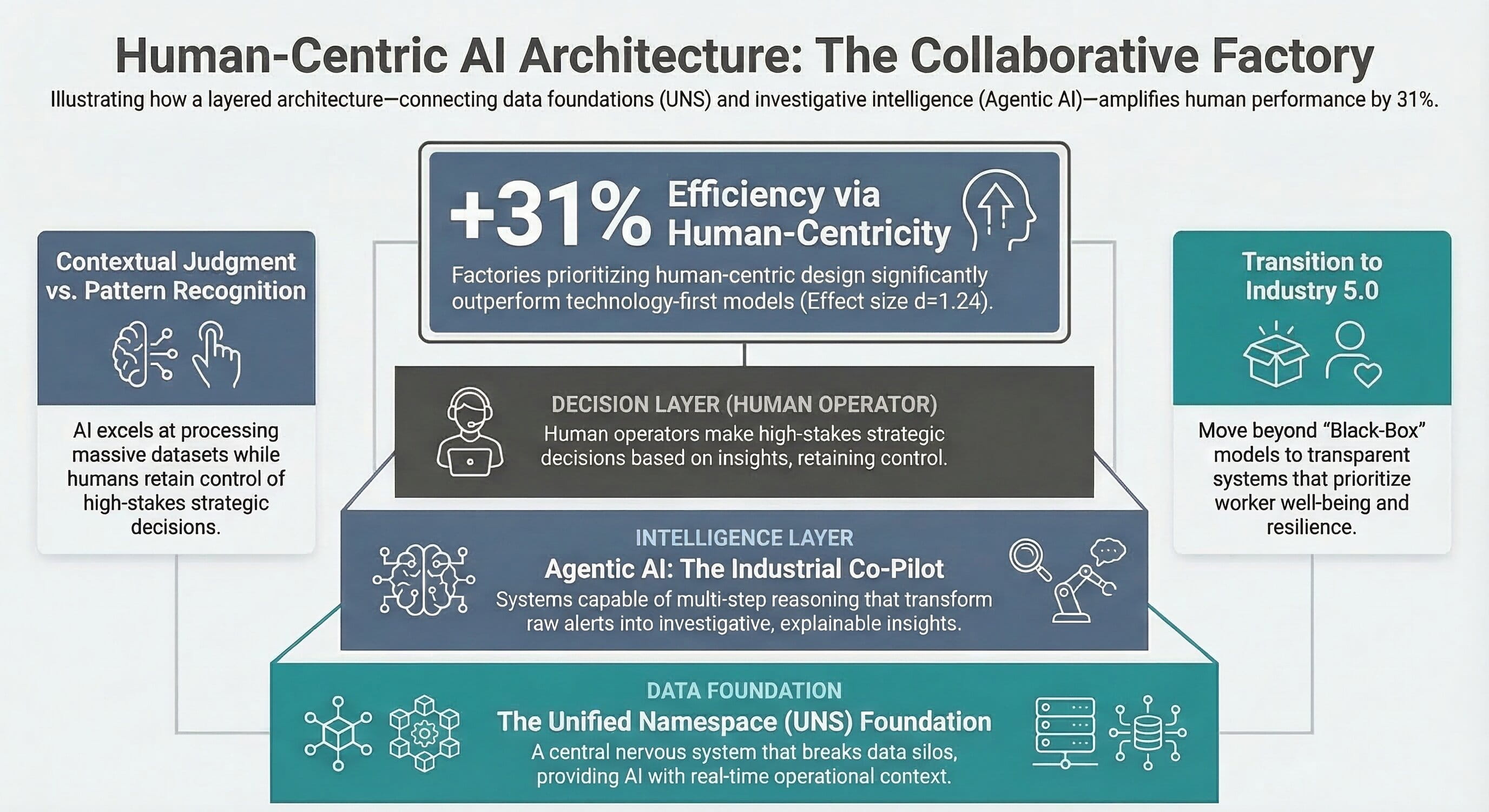
| Layer | Role in the smart factory | Why it matters |
|---|---|---|
| Industrial data infrastructure | Sensors, machines, and operational systems generate continuous plant events and states. | Without reliable event flow, there is no trustworthy digital operating picture. |
| Unified Namespace | Publishes data into a common contextual model that connects machines, processes, and enterprise systems. | Provides the shared data backbone required for real-time plant-wide reasoning. |
| Agentic intelligence layer | Monitors events, investigates anomalies, correlates signals, and recommends actions. | Converts raw data into structured insight instead of alert noise. |
| Human decision interface | Presents explanations, priorities, and next-best actions to operators, engineers, and managers. | Keeps accountability with people while improving speed and quality of response. |
The Unified Namespace as the factory’s contextual nervous system
Without a shared namespace
- Signals remain isolated in application silos
- AI models see local patterns, not operational reality
- Cross-system diagnosis becomes slow and manual
- Decision quality depends too heavily on tribal knowledge
With a Unified Namespace
- Every system contributes to a common operational context
- AI can evaluate plant state, not just single-variable drift
- Operators receive explanations linked to production reality
- New use cases scale faster because the data backbone is reusable
A day in the life of a human-centric smart factory
Consider a packaging machine that begins to show subtle vibration anomalies. In a conventional environment, this might generate a generic alarm and force a person to start piecing together the story manually. In a human-centric AI environment, the response is materially different.
Vibration deviates from historical behavior
The plant data backbone receives the abnormal vibration stream as it happens.
The agent checks plant reality
Maintenance history shows a similar signature six months earlier tied to bearing wear. Production records show a recent shift to a higher-speed packaging configuration. Temperature signals indicate mild overheating.
The AI forms an evidence-backed hypothesis
Instead of saying “abnormal vibration detected,” it states that the pattern is consistent with early bearing degradation under a changed operating regime.
The operator stays in control
The system recommends inspection within the next two maintenance windows and explains why. The operator confirms the action. Downtime is avoided, and trust in the system increases.
What manufacturing leaders should take from this shift
Preserve scarce expertise
Experienced operators are retiring faster than many organizations can replace them. Human-centric AI helps retain institutional knowledge by making decision logic more visible and reusable.
Reduce decision latency
When systems investigate and explain before escalation, teams spend less time gathering facts and more time choosing a response.
Scale digital transformation more credibly
Plants adopt what they trust. Explainability, context, and practical human workflows create a stronger scaling path than “lights-out” narratives.
Implementation path: how to move from dashboards to collaborative intelligence
Phase 1 — Stabilize the data foundation
- Connect critical machine and process signals
- Model contextual state through a Unified Namespace
- Prioritize a small set of operationally meaningful use cases
Phase 2 — Add explainable decision support
- Deploy AI that explains reasoning in plant language
- Present recommendations with evidence, not just alerts
- Capture operator feedback to improve trust and accuracy
Phase 3 — Introduce agentic workflows
- Investigate anomalies across maintenance, quality, and production context
- Automate multi-step diagnostics where evidence is reliable
- Escalate action recommendations with role-based visibility
Phase 4 — Enable bounded semi-autonomy
- Automate safe parameter adjustments under predefined rules
- Optimize maintenance and energy response windows
- Keep humans responsible for strategic and exceptional decisions
Why the smart factory still needs humans
Fully autonomous factories remain an attractive vision, but industrial operations are shaped by ambiguity, trade-offs, and unexpected events. AI is exceptionally strong at pattern recognition and large-scale signal analysis. Humans remain strong at contextual judgment, exception handling, and responsibility under uncertainty.
The highest-performing factories will therefore not be the ones that remove people most aggressively. They will be the ones that combine machine intelligence and human expertise into a unified decision ecosystem that is trusted, explainable, and operationally grounded.
Conclusion: the real future of industrial intelligence
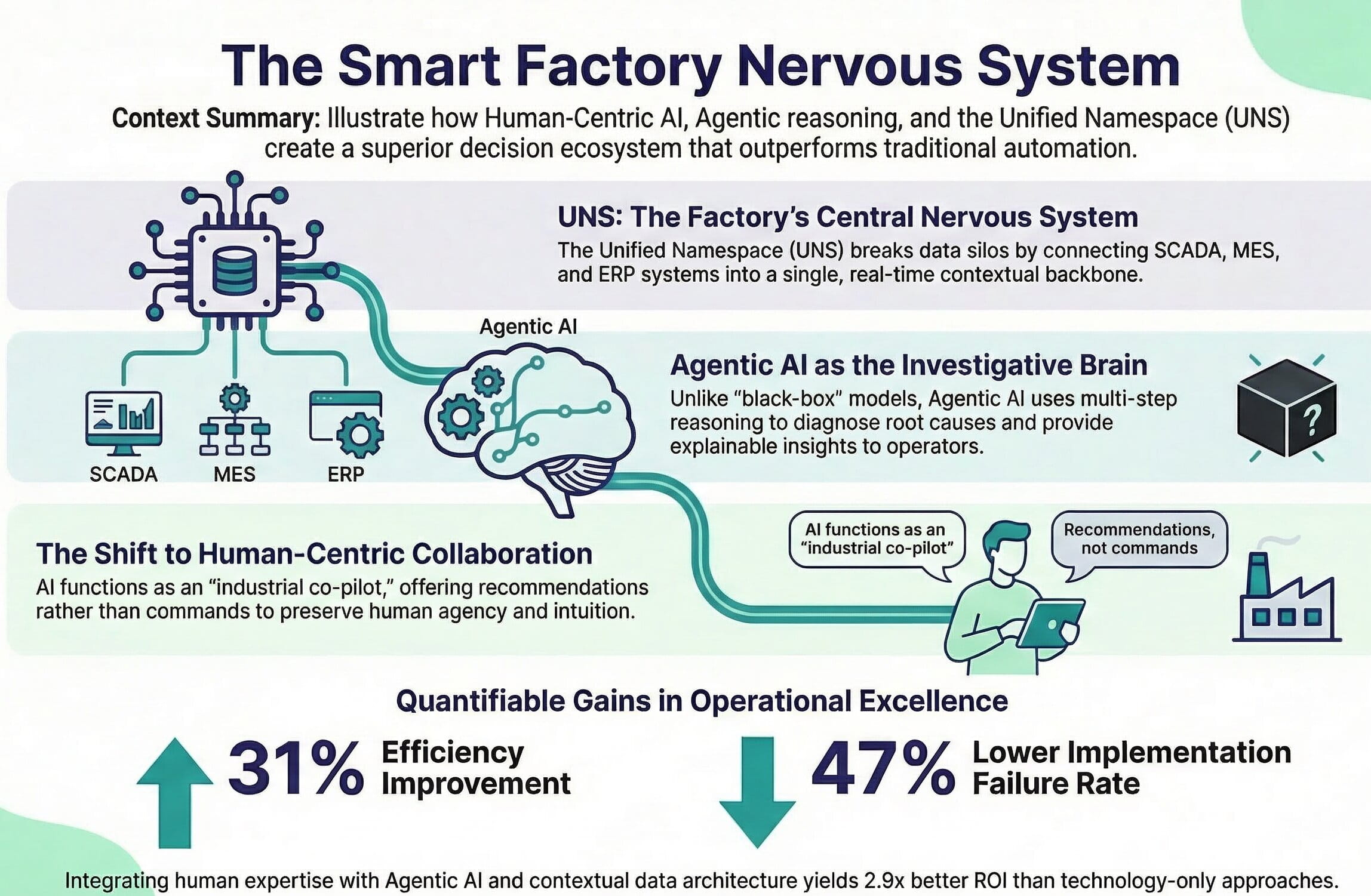
The next wave of industrial transformation will not be defined by robots replacing workers. It will be defined by AI systems collaborating with humans. Human-centric AI makes decisions understandable and trustworthy. Agentic AI turns analytics into investigation and recommendation. The Unified Namespace provides the contextual structure that allows those systems to reason across the full factory.
Together, these capabilities create a factory where humans and machines think together. In the real world of manufacturing, that may be the most important innovation of all.
Enhanced Full Blog Text — Board-Ready Report Format
Executive summary: Modern manufacturing has discovered a hard truth: more industrial data does not automatically create better decisions. The factories that will outperform in the next phase of digital transformation are those that combine human-centric AI, agentic systems, and a Unified Namespace to create explainable, contextual, decision-support intelligence. This report presents the full narrative in a board-ready structure while preserving the complete original content.
The Smart Factory Still Needs Humans
How Human-Centric AI, Agentic Systems, and the Unified Namespace Are Changing Industrial Decision-Making
A no-nonsense guide for manufacturing leaders navigating the next wave of industrial AI.
Introduction: The Factory of the Future Is Not Run by Robots Alone
For the last decade, the manufacturing world has been sold a compelling narrative.
Factories would become fully autonomous.
Machines would make decisions.
Artificial intelligence would optimize everything.
Humans, according to the more dramatic predictions, would simply supervise—or disappear entirely.
Yet when you walk through a modern manufacturing plant today, something interesting happens.
You still see humans everywhere.
Operators interpret machine behavior.
Engineers troubleshoot anomalies.
Maintenance teams rely on intuition built from years of experience.
Despite the explosion of sensors, industrial IoT platforms, and machine learning models, the final decision in most factories still belongs to a human being.
This is not a failure of technology.
It is reality.
Factories are complex socio-technical systems where data, machines, and human expertise intersect.
The next evolution of industrial intelligence therefore is not about removing humans from the loop.
It is about building AI systems that collaborate with humans.
This shift has given rise to a powerful concept:
Human-Centric AI.
But here is the interesting twist.
Human-centric AI is only possible when two other architectural components come together:
- Agentic AI systems capable of reasoning and acting
- A contextual data backbone such as the Unified Namespace
When these three elements combine, factories move beyond dashboards and alerts toward something far more valuable:
Intelligent decision ecosystems.
And that is where the real transformation begins.
The Problem with Today’s “Smart Factory” Systems
If you ask manufacturing leaders what frustrates them about digital transformation projects, the answers are remarkably consistent.
They will say things like:
- “We have too many dashboards.”
- “We collect enormous amounts of data but still make decisions manually.”
- “Operators are overwhelmed with alerts.”
In many factories, the situation looks something like this:
- dozens of dashboards
- thousands of sensor readings
- endless alarm notifications
- data stored in disconnected systems
The result?
Data overload.
Ironically, the more “digital” a factory becomes, the harder it can be to extract actionable decisions.
Operators are forced to interpret data themselves.
Engineers manually correlate signals across systems.
Managers rely on experience rather than analytics.
The promise of Industry 4.0 was supposed to change that.
Instead, many factories simply became better at collecting data—not making decisions.
Why Traditional Industrial AI Has Struggled
Artificial intelligence has been deployed in manufacturing for years.
Predictive maintenance models, anomaly detection algorithms, and quality analytics systems are widely used.
Yet adoption often stalls.
Why?
Because traditional industrial AI systems suffer from three critical problems.
Problem 1: Black-Box Models
Many AI models generate predictions without explaining why.
In consumer applications this might be acceptable.
In factories, it is unacceptable.
When an AI system recommends shutting down a machine producing €50,000 per hour in output, the operator will ask a very simple question:
“Why?”
If the AI cannot explain its reasoning, trust disappears instantly.
Problem 2: Lack of Context
Factories are not just machines and sensors.
They are ecosystems that include:
- production schedules
- maintenance history
- environmental conditions
- operator behavior
- supply chain events
Traditional AI systems often analyze isolated data streams rather than contextual factory data.
This results in insights that are technically correct—but operationally useless.
Problem 3: Decision Responsibility
Even when AI provides recommendations, the responsibility for action still belongs to humans.
Shutting down a machine, adjusting production parameters, or triggering maintenance carries real operational risk.
No plant manager will delegate that responsibility to an opaque algorithm.
Which leads to a simple truth.
Factories do not want autonomous AI.
They want decision-support AI.
Enter Human-Centric AI
Human-centric AI is not about replacing human expertise.
It is about augmenting it.
Instead of treating humans as an obstacle to automation, human-centric systems treat them as an essential part of the intelligence loop.
In practical terms, this means AI systems should:
- explain their reasoning
- provide recommendations rather than commands
- adapt to human feedback
- collaborate with operators and engineers
Think of it less like an autonomous robot and more like a highly intelligent industrial co-pilot.
In this model:
- AI analyzes patterns across massive datasets
- humans provide contextual judgment and operational experience
Together, they form a decision system that is far more powerful than either component alone.
The Missing Piece: Agentic AI
While human-centric AI focuses on collaboration, another technological development is rapidly emerging in industrial environments.
Agentic AI.
Agentic AI refers to systems capable of:
- autonomous reasoning
- multi-step decision workflows
- goal-driven problem solving
Unlike traditional analytics tools, agentic systems can perform tasks such as:
- investigating anomalies
- correlating signals across machines
- diagnosing root causes
- recommending corrective actions
Imagine an AI system detecting abnormal vibration on a machine.
Instead of simply raising an alarm, an agentic AI system could:
- analyze historical maintenance records
- compare vibration patterns across similar machines
- check recent production changes
- correlate temperature and load conditions
- identify likely failure causes
Then present a structured explanation to the operator.
In other words:
Agentic AI transforms raw analytics into investigative intelligence.
But there is still one critical requirement.
Agentic systems need contextual access to factory data.
And this is where architecture becomes important.
The Role of the Unified Namespace
Industrial data is notoriously fragmented.
Sensors send data to SCADA systems.
Machines connect to PLCs.
Production data lives in MES platforms.
Enterprise information sits inside ERP systems.
For AI to make intelligent decisions, these data sources must be connected.
The Unified Namespace (UNS) solves this problem by creating a real-time data backbone for the entire factory.
Instead of isolated systems, all events and data streams are published into a common structure.
Think of the Unified Namespace as the central nervous system of the factory.
Every machine, system, and application contributes data to the same contextual model.
This allows any application—including AI systems—to access the full operational picture.
Without such a data backbone, agentic AI cannot function effectively.
The Architecture of Human-Centric Decision Systems
When these technologies come together, a powerful architecture emerges.
Instead of dashboards feeding humans directly, factories begin to implement a layered intelligence model.
At the foundation lies the industrial data infrastructure.
Sensors, machines, and systems generate continuous operational data.
This data flows into a contextual backbone such as the Unified Namespace.
On top of this data layer sits the intelligence layer.
Agentic AI systems monitor events, analyze patterns, and generate insights.
But rather than acting autonomously, they collaborate with human operators.
The final layer is the human decision interface.
Operators, engineers, and managers receive structured insights and recommended actions.
The decision remains human—but it is now supported by intelligent systems.
A Day in the Life of a Human-Centric Smart Factory
To understand how this works in practice, imagine the following scenario.
A packaging machine begins to show subtle vibration anomalies.
Traditional systems might simply trigger an alarm.
In a human-centric AI environment, something different happens.
First, sensors stream vibration data into the factory’s data backbone.
An agentic AI system detects a deviation from historical patterns.
Instead of issuing a generic alert, the system investigates further.
It analyzes maintenance records and identifies that a similar vibration signature occurred six months earlier due to bearing wear.
It checks production schedules and sees that the machine recently switched to a higher-speed packaging configuration.
It correlates temperature readings and identifies slight overheating.
The AI system then generates a structured insight.
It informs the operator that the vibration pattern suggests early bearing degradation and recommends inspection within the next two maintenance windows.
It also explains how it reached this conclusion.
The operator reviews the recommendation and confirms the maintenance action.
The result?
A potential failure is avoided.
Downtime is minimized.
And the operator remains in control.
Why This Matters for Manufacturing Leaders
The shift toward human-centric decision systems is not just a technological evolution.
It is an operational necessity.
Factories face increasing pressure from multiple directions.
Supply chains are unpredictable.
Energy costs fluctuate dramatically.
Production complexity continues to rise.
At the same time, experienced operators are retiring faster than new ones can be trained.
Manufacturers must therefore find ways to preserve institutional knowledge while augmenting human expertise with intelligent systems.
Human-centric AI provides exactly that.
Instead of replacing human judgment, it amplifies it.
The Road Ahead: Semi-Autonomous Factories
Looking forward, industrial AI will evolve through several stages.
Initially, factories relied primarily on dashboards and manual interpretation.
The next phase introduced analytics and predictive models.
Today, many manufacturers are beginning to adopt decision-support systems powered by AI.
The future, however, will likely involve semi-autonomous operations.
In these environments, AI systems continuously analyze factory conditions and recommend actions.
Humans remain responsible for strategic decisions, but operational responses become increasingly automated.
Machines might adjust parameters automatically under predefined rules.
Maintenance scheduling could be dynamically optimized.
Energy consumption might be autonomously balanced across production lines.
But the key principle will remain unchanged.
Humans will remain part of the loop.
Because factories are not purely technical systems—they are human systems.
Why the Smart Factory Still Needs Humans
The idea of fully autonomous factories is appealing.
But it misunderstands the nature of industrial operations.
Manufacturing is filled with ambiguity, trade-offs, and unexpected events.
Human intuition plays a critical role in navigating these situations.
AI excels at pattern recognition.
Humans excel at contextual judgment.
The most powerful factories of the future will therefore not be those that eliminate humans.
They will be those that combine machine intelligence and human expertise into a unified decision ecosystem.
Conclusion: The Real Future of Industrial Intelligence
The next wave of industrial transformation will not be defined by robots replacing workers.
It will be defined by AI systems collaborating with humans.
Human-centric AI ensures that decisions remain understandable and trustworthy.
Agentic AI enables machines to investigate problems and generate insights.
The Unified Namespace provides the contextual data foundation that connects everything together.
Together, these technologies enable something far more powerful than automation.
They enable intelligent factories where humans and machines think together.
And in the complex world of manufacturing, that collaboration may prove to be the most important innovation of all.
Because despite all the advances in artificial intelligence, one truth remains.
When a production line stops unexpectedly at 3 a.m., the factory still calls a human.
And now, finally, that human might have an extremely intelligent assistant.
Arjun updated on 19 Nov 2025, 08:15AM
This is one of the better explanations I’ve seen of why plants keep investing in analytics but still struggle to improve response time on the floor. The distinction between data collection and decision support is exactly where many programs stall.Hannah updated on 19 Nov 2025, 10:02AM
Agreed. We learned the hard way that another dashboard does not create operational confidence. The moment we started framing outputs as recommended actions with context, operators actually engaged.Lukas updated on 20 Nov 2025, 07:48AM
The point on black-box models is critical. In process manufacturing, nobody is going to accept an AI recommendation that could interrupt a high-value line unless the reasoning path is visible and tied to plant reality.Neha updated on 20 Nov 2025, 09:11AM
Yes, and that “why” has to include production mode, maintenance state, operator interventions, and recent changeovers. Otherwise the model may be statistically right and operationally wrong.Oliver updated on 20 Nov 2025, 02:36PM
What stood out to me was the positioning of UNS as the contextual backbone rather than just another integration layer. Too many architectures still treat OT, MES, and ERP as separate reporting islands.Kavya updated on 20 Nov 2025, 04:05PM
Exactly. Once data is modeled around events and state instead of isolated tags, it becomes much easier for AI agents to investigate rather than simply alert.Miriam updated on 21 Nov 2025, 09:24AM
The packaging-machine scenario is realistic. Most teams I work with do not need full autonomy; they need systems that narrow the diagnosis, explain likely causes, and recommend an action window.Sanjay updated on 21 Nov 2025, 12:42PM
The labor angle matters too. Experienced technicians are retiring, and a lot of operational judgment is still trapped in people rather than systems. Human-centric AI feels like a more credible knowledge-retention strategy than “lights-out” marketing.Felix updated on 21 Nov 2025, 01:27PM
That’s the real value in my view. If AI can surface patterns while preserving operator judgment, you reduce dependence on tribal knowledge without creating a trust gap.Priyanka updated on 22 Nov 2025, 08:05AM
I also liked the semi-autonomous framing. It is much more practical to automate bounded responses under predefined rules than to pretend every plant is ready for fully autonomous control.Jonas updated on 22 Nov 2025, 10:18AM
Well said. We’ve had success with automatic parameter adjustments inside a safe range, but escalation still goes to a human. That balance is where adoption happens.Rebecca updated on 23 Nov 2025, 11:33AM
The article captures something many executive teams miss: factories are socio-technical systems. Digital transformation succeeds when architecture, workflow, and human responsibility are designed together.Vivek updated on 24 Nov 2025, 03:14PM
Would be interesting to see a follow-up on how this architecture connects to CMMS, quality workflows, and energy optimization. The decision-support angle seems especially strong for cross-functional use cases.Greta updated on 24 Nov 2025, 05:01PM
I was thinking the same. Once the context layer is stable, the use cases expand quickly beyond maintenance into quality, scheduling, and even sustainability reporting.