
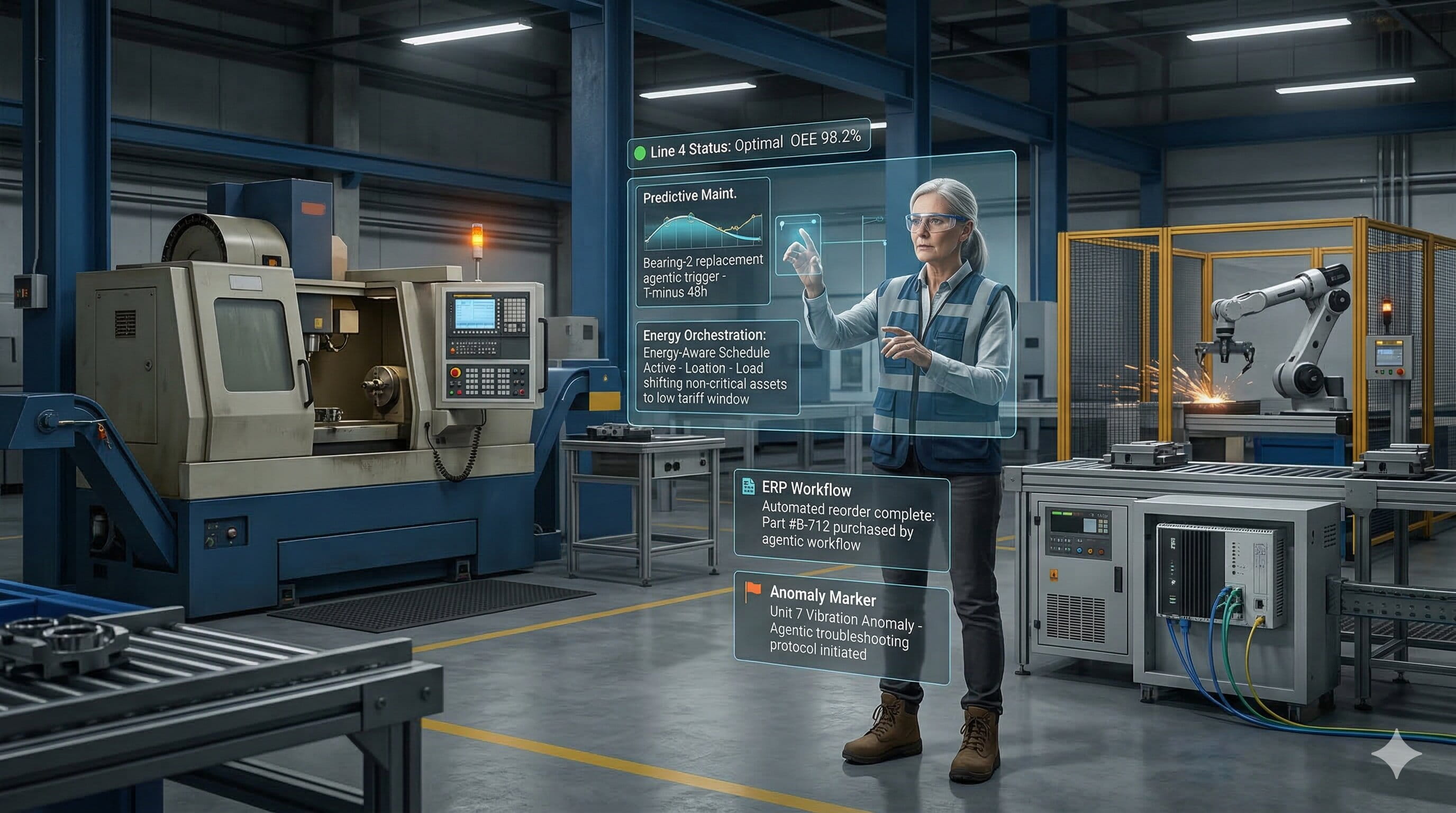
Industrial leaders no longer win by seeing more. They win by deciding faster, automating intelligently, and embedding operational judgment directly into the fabric of the factory. This article reframes asset tracking as a strategic gateway to agentic industrial intelligence rather than a visibility project.
Executive Snapshot
1. The Dashboard Delusion: Visibility Without Agency
Why “real-time dashboards” are no longer enough in an industrial environment defined by speed, scarcity, and margin pressure.
For years, industrial digitalization was sold as a visibility story. Install sensors. Connect machines. Stream telemetry. Show everything on a beautiful screen. The promise sounded transformational: total awareness, real-time control, and cleaner decisions.
But the operating reality is harsher. When a dashboard shows a throughput decline, a missed inventory threshold, or a bearing approaching failure, nothing is solved by the screen itself. Someone still has to notice the alert, understand the implication, gather the right people, and decide what action to take.
That lag between detection and decision is where value quietly disappears. In 2026, smart operations are shifting from passive connectivity to active autonomous orchestration. If a system only points at a problem but cannot trigger the right operational response, it remains a diagnostic interface rather than an industrial operating layer.
“If your software operates like a manager who only points at problems without actually fixing them, that manager gets fired.”
The Hawk-Like Trap
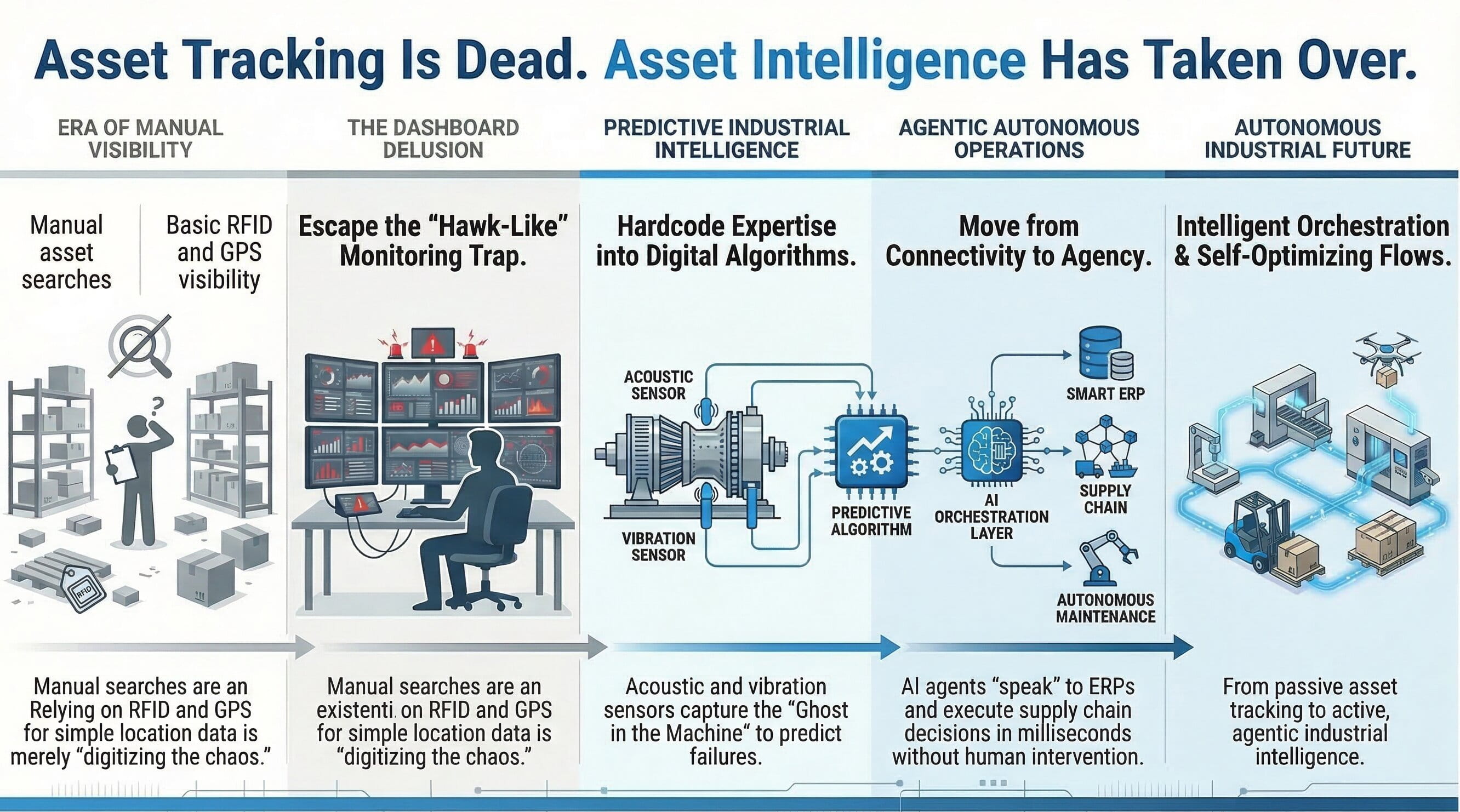
Many factories now have better visibility than ever, yet still require humans to continuously watch screens, interpret signals, and manually coordinate action. That is not full automation. It is digitized supervision.
2. Architecture Framework: Brownfield-First, AI-Ready
A practical model for connecting legacy equipment, preserving sovereignty, and enabling machine-driven workflows.
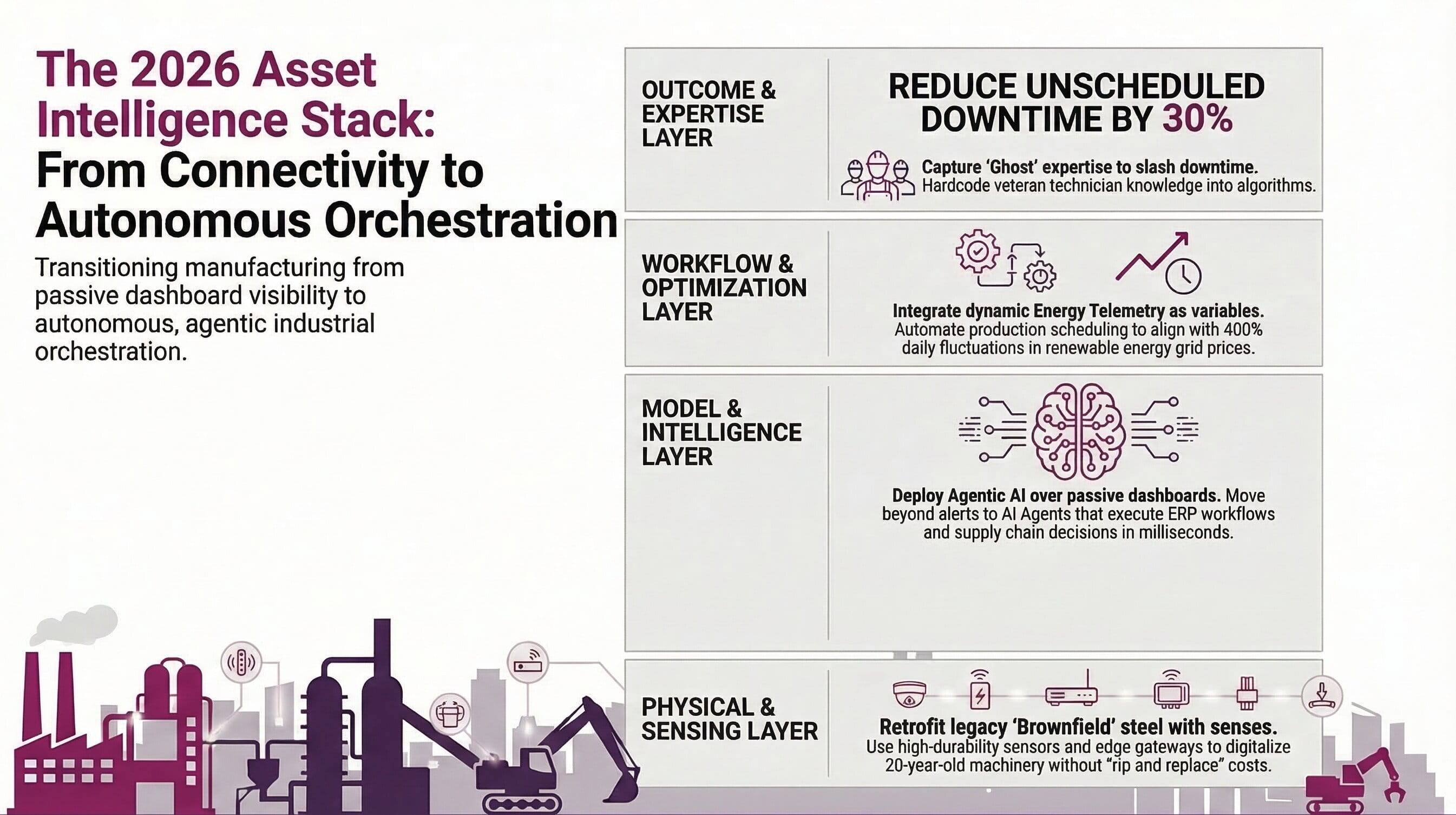
Retrofitted Sensing
Add robust sensors and edge gateways to existing equipment instead of replacing still-productive machines.
Protocol Translation
Convert brownfield machine signals into interoperable digital events consumable by modern applications and AI agents.
Edge-First Security
Keep sensitive telemetry inside the facility wherever sovereignty, latency, or customer trust make cloud-first designs risky.
ERP/Workflow Integration
Allow operational events to initiate replenishment, maintenance, scheduling, and record updates across enterprise systems.
Agentic Decision Layer
Move from alerts to governed autonomous action under business rules, thresholds, and approval logic.
Most industrial companies do not operate greenfield showrooms. They operate mixed-age factories full of proven machines that still generate profit. That makes “rip and replace” a financially destructive strategy for many Tier-1 suppliers and mid-market manufacturers. The more credible path is the Brownfield Bridge: upgrading what already works by adding digital sensing, protocol mediation, and AI-ready data flows.
This is not just about connectivity. It is about building enough architectural flexibility to let a 20-year-old machine participate in a modern decision loop without forcing the plant into a costly platform reset.
Evolution of Asset Intelligence
3. Knowledge Capture: Replacing Lost Tacit Expertise
Why asset intelligence must absorb human know-how as experienced technicians leave the floor.
Predict Failures Earlier
Acoustic monitoring and vibration analysis can capture patterns that experienced technicians historically detected through intuition and repetition.
Reduce Downtime
Condition-aware maintenance planning helps cut unplanned stoppages and recover productivity that would otherwise disappear into reactive repairs.
Automate Precision
Record updates, maintenance logging, and threshold-driven actions become more reliable when critical workflows stop depending on manual spreadsheets and memory.
The labor problem is not only about headcount. It is about the disappearance of tacit operational intelligence. Plants are losing the people who know how a machine sounds before a belt slips, how a tool behaves before tolerance drifts, and which interventions actually stabilize output under pressure.
The “Shadow Expert” model addresses this by encoding experienced judgment into digital detection and response layers. In that model, asset intelligence becomes more than telemetry. It becomes a mechanism for preserving operational memory.
4. Energy as a Live Production Variable
Modern asset intelligence must connect physical flow, machine status, and energy economics in real time.
Tracking only physical position is no longer enough. Manufacturing economics are now affected by large and rapid swings in energy cost, making electricity consumption an operational variable rather than a back-office utility line.
That changes how factories should orchestrate work. Energy telemetry must be tied to ERP, scheduling, and machine-state context so that energy-intensive runs can move toward lower-cost windows and carbon reporting can become a reliable supplier capability rather than a manual afterthought.
What changes when energy telemetry is integrated?
Resource optimization: asset flow data reveals where energy waste hides inside movement, waiting, and inefficient equipment usage.
Grid-aware scheduling: AI can time production activity around favorable price conditions instead of reacting after costs have already spiked.
Digital product passport readiness: carbon-footprint-per-unit reporting becomes more credible and more scalable.
Want to Watch?
5. The Compliance Fortress: Security as Industrial Entry Fee
Connected assets create value only when security, sovereignty, and compliance are designed into the operating model from the start.
As plants increase the number of connected endpoints, they also expand operational risk. In this environment, “security later” is no longer a tolerable implementation philosophy. A modern asset intelligence stack must be built around encryption, zero-trust assumptions, and tightly governed data movement.
For European manufacturers and the German Mittelstand especially, this is as much a commercial issue as a technical one. Customers expect trusted handling of production and supply-chain data. Compliance is not a box-checking exercise. It is part of market access, supplier credibility, and competitive resilience.
Security-by-Design
Protect proprietary industrial data through architecture decisions made at the beginning, not as a post-project patch.
Sovereign Operations
Use edge-first deployment patterns where sensitive telemetry should remain within factory walls unless explicitly and securely shared.
Trust Advantage
Reliable fulfillment matters, but trusted data stewardship increasingly matters just as much to strategic customers.
Prefer to Listen?
6. Escaping Pilot Purgatory: The ROI Proof Model
A lean execution path that proves value quickly and creates a credible path from proof-of-concept to scale.
| Execution Principle | What It Looks Like | Why It Matters |
|---|---|---|
| Small PoCs, sharp outcomes | Begin with a focused €10K–20K proof tied to one painful operational bottleneck. | Creates trust through evidence instead of asking for large budget commitment upfront. |
| Lean delivery model | Use AI heavily in analysis, modeling, and implementation tasks while avoiding bloated toolchains. | Improves economics and keeps resource pressure low for both provider and client. |
| Smart resource allocation | Keep relationship-heavy local work close to the client while distributing technical production efficiently. | Balances cost control with customer trust and delivery quality. |
| Value-first engagement | Lead with audits, checklists, and diagnostic guidance before large-scale transformation commitments. | Filters for readiness and aligns expansion with measurable operational gains. |
Implementation Path: From Tracking to Agency
A practical sequence for industrial teams that need progress without disruption.
Instrument the bottleneck
Select the line, asset group, or inventory process where poor visibility already creates measurable business pain.
Connect brownfield assets
Add sensors, gateways, and event translation so legacy equipment can participate in a modern data flow.
Establish governed action rules
Define which events create alerts, which create workflow triggers, and which allow supervised autonomous action.
Integrate ERP, maintenance, and energy context
Move beyond machine data alone by connecting business systems and production economics.
Scale only after measurable proof
Expand to adjacent processes once downtime, cost, labor efficiency, or response-time improvements are demonstrated.
Stop Watching the Fire: The 2026 Survival Mandate
The strategic question is no longer whether assets can be seen, but whether they can act with governed intelligence.
Asset tracking is no longer a novelty. It is only the foundation. The real competitive advantage now comes from giving assets enough digital context, enough workflow integration, and enough AI-enabled agency to participate in the operation itself.
That means moving beyond dashboards, beyond sensor count, and beyond passive monitoring. It means building systems that reduce labor dependency, preserve expertise, optimize around energy volatility, strengthen compliance posture, and convert signals into action with speed and discipline.
The defining industrial question of 2026 is not whether you can see your assets on a screen. It is whether your assets are smart enough to survive and operate without you watching them.
Enhanced Full Blog Text — Board-Ready Report Format
Beyond Asset Tracking: Empowering the 2026 Industrial Survivor with Agentic AI
Executive summary: Industrial operators have reached a strategic inflection point. Passive asset tracking is no longer an adequate operating model for factories facing labor scarcity, brownfield complexity, energy volatility, and rising compliance pressure. The argument of this report is direct: the future belongs to organizations that move beyond visibility and toward agentic industrial intelligence—systems that do not merely report events, but help orchestrate operational action with speed, consistency, and precision.
By Technical IoT Experts
Have you ever misplaced your keys, spent an entire morning tearing apart your living room, and walked out the door an hour late? It is a classic human blunder—frustrating, but ultimately manageable. Now, scale that feeling. Imagine your business’s multi-million Euro assets simply “disappearing” in the middle of a high-stakes, time-sensitive production run.
Suddenly, you aren't just dealing with a lost morning. You are looking at a lost quarter, a deeply damaged reputation, and, in today's hyper-competitive landscape, potentially a lost company. Welcome to the unforgiving industrial reality of 2026. We have reached a critical inflection point where “looking for things” is no longer an acceptable operational inconvenience—it is an existential failure.
If your company is still relying on passive tracking and human intervention to solve these problems, you are walking into the future blindfolded. Here is exactly why the legacy IoT playbook is burning to the ground, and how true leaders are rebuilding and empowering their operations with Agentic Industrial Intelligence.
Chapter 1: The Dashboard Delusion and the “Hawk-Like” Trap
Let’s be brutally honest for a moment. Buzzwords like “IoT” and “Industry 4.0” come and go with the wind, but the fundamental business need to operate calmly, proactively, and profitably is eternal. For the last decade, the manufacturing world has been absolutely obsessed with the concept of “visibility”.
The pitch was seductive: “the Internet of Things” was going to act like the internet itself grew legs, marched into your warehouse, tracked your assets, and kept your floor running like a super-competent operations manager. Companies spent millions building digital “eyes” so they could track every forklift, every pallet, and every machine on a massive high-definition screen in a climate-controlled, glass-walled office.
But here is the million-dollar question: When the data on that beautiful screen shows a 15% drop in throughput, or signals a critical bearing failure on a vital machine, what actually happens?
In the vast majority of so-called “Smart Factories,” the system simply sits there. It waits. It flashes red and waits for a human to happen to look at the screen, call a corporate meeting, deliberate over coffee, and eventually decide what action to take. In 2026, a “dashboard” is no longer a tool of the future; it is merely a high-definition tombstone for your productivity. If you are still celebrating the launch of a “Real-Time Dashboard” today, you aren’t leading your industry—you are methodically documenting your own obsolescence.
In 2026, the entire value proposition of IoT has violently shifted away from mere “Connectivity” and toward “Autonomous Orchestration”. Having eyes on your assets 24/7 sounds like a massive victory until you realize you have fallen into the “Hawk-Like” Trap: you now need an entire team of interns or analysts just to sit and watch the monitors. Real-time visibility should be a second-nature foundation, not a full-time job.
If your software operates like a manager who only points at problems without actually fixing them, that manager gets fired. Why on earth should your technology stack be treated any differently? If your “Smart Factory” still requires a human to run in and “save the day” when a threshold is breached, you haven't automated anything; you’ve just digitized your chaos.
True 2026 industrial leaders are moving from data to decisiveness. They are deploying systems where devices don't just alert humans, but “speak” directly to the ERP, executing complex supply chain decisions in milliseconds without human intervention. Imagine an AI Agent that doesn't just send a push notification when inventory drops, but acts as a ruthless virtual assistant—handling the reordering, updating the ledger, and optimizing the delivery route without errors, and without ever taking a coffee break.
Chapter 2: The Brownfield Resurrection
Open any sleek marketing brochure from a legacy hardware vendor, and you will see gorgeous “Greenfield” factories. These pristine environments feature gleaming white floors where every single machine is “IoT-native” out of the box.
But seasoned technical experts know the reality. For the powerhouse Tier-1 suppliers and the backbone of the German mid-market, the industrial reality is a beautiful, chaotic mess of grease, dust, and heavy legacy hardware. A typical, highly profitable supplier is not going to bankrupt themselves buying a fleet of new machines; they are running 20-year-old steel that was built decades before anyone thought to make it “talk” to the cloud.
The greatest fallacy in the industry today is the “rip and replace” model. Let us be clear: this is a weak, financially toxic idea pushed by hardware vendors whose primary goal is to sell you new iron that you simply do not need. The real magic—and the real expertise—lies in mastering the Brownfield Bridge.
How do you teach an old CNC machine new tricks?
- Retrofitting the Future: You don't need a new machine; you need new senses. By utilizing high-durability sensors and specialized edge gateways, we can digitalize an entirely analog factory floor for a tiny fraction of the cost of replacing the equipment.
- Software-Defined Flexibility: The mid-market requires agility, which is why open-source foundations are critical. You don't need to be locked into a vendor's proprietary “black box.” You need a deeply flexible architecture that seamlessly translates the mechanical grunts of a 1998 lathe into the sophisticated digital language of a 2026 AI agent.
- Uncompromising Data Sovereignty: European firms, particularly in Germany, are rightfully paranoid about industrial espionage and data privacy. Sending sensitive production telemetry to a public cloud is often a non-starter. Keeping this data securely inside the factory walls on an on-premise server is not a luxury; it is a non-negotiable requirement.
The ultimate goal of the Brownfield Bridge is to transport your operations from a state of frantic reactivity to one that is calm, collected, and relentlessly proactive.
Chapter 3: The Ghost in the Machine and the Demographic Time Bomb
You can have the greatest software in the world, but the single greatest threat to industrial stability in 2026 is not a lack of technology. It is a terrifying lack of people.
The industry is currently being crushed by a staggering 1.2 million worker shortfall in key technical markets. Think about your most senior technician. Think about the person who has spent 30 years walking the factory floor, the one who knows exactly “how the machine sounds” right before it throws a belt or blows a seal. When that technician retires, they don't just leave an empty locker; they take an invisible, invaluable operational asset out the door with them.
You simply cannot “track” your way out of a missing workforce. The strategy must immediately shift to Automated Knowledge Capture.
We believe in digitizing the very soul of your operational expertise. We do this by capturing the “ghost in the machine”:
- Predicting Failures Before They Happen: We utilize advanced acoustic sensors and ultra-sensitive vibration analysis to capture the veteran technician's “gut feeling” and hardcode it into a relentless digital algorithm.
- Slashing Downtime: By constantly monitoring machine health and intelligently optimizing maintenance schedules, facilities are reducing unscheduled downtime by 30%. This translates to hundreds of thousands of Euros saved annually in avoided repair costs and recaptured productivity.
- Precision Over Paperwork: Humans make mistakes. They misplace decimal points in spreadsheets. By automating record updates, you ensure flawless precision.
In 2026, the “Shadow Expert” model is how smart companies survive the labor shortage. By leveraging AI to reduce resource pressure, a small, highly efficient team of three people can effectively monitor and run a global operation.
Chapter 4: Watts and Whims – Orchestrating the Kilowatt Constraint
If you are only tracking the physical location of your assets, you are ignoring the most volatile variable in modern manufacturing. In 2026, energy is no longer just a boring utility cost managed by the accounting department at the end of the month; it is a highly dynamic, aggressive production variable.
The industry is being squeezed by energy costs that can violently fluctuate by up to 400% in a single day due to the transition to volatile renewable energy sources. A sudden spike in grid prices can shift a production run's margin from wildly positive to deeply negative in a matter of hours.
Asset tracking in 2026 must completely integrate Energy Telemetry. If your system isn't constantly talking to your energy meter and your ERP simultaneously, you aren't running a smart factory—you are just running an expensive, energy-hungry relic.
- Resource Optimization: Analyzing how assets flow through a facility isn't just about finding floor space; it's about uncovering hidden opportunities to radically reduce the energy footprint of your entire warehouse operation.
- Proactive, Grid-Aware Scheduling: Moving away from “firefighting” means deploying AI that automatically schedules your most energy-intensive production runs for the exact moments when the local grid price bottoms out.
- The “Digital Product Passport”: Sustainability is no longer just a PR exercise. In 2026, rigorously tracking the “Carbon-Footprint-per-Unit” is rapidly becoming a strict legal mandate if you wish to remain a preferred supplier to massive global OEMs.
Chapter 5: The Compliance Fortress
While the boundless possibilities of IoT are thrilling, introducing thousands of connected endpoints into a factory introduces massive risk. Historically, most vendors have treated security as an afterthought—they “sprinkle on security” right at the end of a project just to check a box.
In 2026, operating this way is a direct legal liability. With the aggressive enforcement of the Cyber Resilience Act (CRA) and the unforgiving global data mandates of GDPR, security must be weaponized to protect your business. If you cannot guarantee a true “Zero-Trust” environment, you are failing the basic entry fee for the modern market.
- Security-by-Design: You must implement ironclad encryption protocols and zero-trust architectures from the ground up to protect your most valuable asset: your proprietary data.
- Sovereign Compliance: For the German Mittelstand, compliance means adopting a strict “Edge-First” approach. This guarantees that absolutely no sensitive data ever leaves the physical walls of the factory without explicit, deeply encrypted permission.
- Trust as a Competitive Advantage: Happy customers aren't just those who receive accurate delivery times. In the modern era, happy customers are those who sleep soundly knowing their proprietary supply chain data is locked in a fortress. True 2026 technical experts safeguard the absolute integrity of the data that your inventory generates.
Chapter 6: Escaping Pilot Purgatory (The ROI of Agency)
Vision without execution is just hallucination. The reason so many digital transformations fail is that they get stuck in “Pilot Purgatory.” To successfully move your operations from “firefighting” to “preventing,” your execution model must be lean, AI-first, and aggressively results-driven.
The “big consulting firm” model—defined by cripplingly high retainers, massive bloat, and endless team meetings—is completely dead. Our blueprint for ROI is designed for reality:
- Small PoCs to Big Wins: We don't ask for a blank check. We start with a low-cost Proof of Concept (typically €10K-20K) to prove our worth. We build trust by attacking one specific, highly painful bottleneck—such as proving we can reduce unscheduled downtime by 30%.
- Lean Operational Costs: We utilize AI extensively to deliver the solution, keeping resource pressure low. We don't implement fancy, bloated software tools unless they provide a massive, measurable return on time saved.
- Smart Resource Allocation: By maintaining strict separation between the front and backend, we ensure local relationships are handled personally, while the heavy technical lifting (AI modeling, data collation) is managed by offshore experts. This keeps margins healthy and costs incredibly low for our clients.
- Value-First Outreach: We don't believe in sales spam. We provide immense upfront value through free consultations, audits, and checklists to honestly assess if a prospect's data is actually “ready” for the 2026 autonomous shift.
Stop Watching the Fire: The Survival Mandate
IoT asset tracking is no longer just a fancy gadget to show off on factory tours. But you must stop simply “tracking” your assets. You must give them the intelligence and the agency to manage themselves.
Most hardware vendors will happily sell you a tool—a gateway, a sensor, or a recurring SaaS subscription. But the true leaders of 2026 provide something much more valuable: the Certainty of an autonomous future.
Stop watching the fire burn on a high-definition screen. Your smartest competitors are already actively automating their decision-making processes, aggressively using AI to slash their resource costs, and systematically eliminating operational friction from their supply chains.
If your company is not actively moving toward an Agentic AI model in 2026, you aren't just standing still—you are moving backward into irrelevance. The future of industry belongs to the agile, the fully automated, and the AI-first.
The defining question of 2026 isn't whether you can see your assets on a screen. The question is: are your assets smart enough to survive and operate without you watching them?
Is your factory ready to think for itself?
Rajiv updated on 19 Mar 2026, 08:12AM
The distinction between “visibility” and “autonomous orchestration” is exactly what many plants still miss. We have dashboards everywhere, but escalation and response are still largely manual.Hannah updated on 19 Mar 2026, 10:01AM
Same experience here. The real bottleneck is not sensor coverage anymore; it is decision latency between alert, approval, and execution.Lukas updated on 19 Mar 2026, 01:46PM
The brownfield section is especially relevant for the German mid-market. Most profitable plants I know are running a mix of equipment generations, and nobody is going to rip out functioning machines just to satisfy a software narrative.Priya updated on 19 Mar 2026, 03:18PM
Agreed. Retrofitting plus edge translation layers is a far more credible path than full replacement, especially where capital discipline is tight.Emily updated on 20 Mar 2026, 09:05AM
The “Hawk-Like Trap” is a strong phrase because it captures the hidden labor cost of so-called smart operations. If a team still needs to stare at screens all day, the system is only partially modernized.Nikhil updated on 20 Mar 2026, 11:27AM
What stood out to me was the point about ERP-connected action. That is where ROI starts becoming visible to leadership—when detection leads directly to replenishment, scheduling, or maintenance workflow execution.Svenja updated on 20 Mar 2026, 01:02PM
Yes, and that is also where governance matters. Autonomous action has to be tied to business rules, not just threshold breaches.Marta updated on 21 Mar 2026, 07:55AM
The workforce angle is underestimated in many board discussions. Plants are not only losing labor capacity; they are losing tacit machine knowledge that was never documented properly.Arun updated on 21 Mar 2026, 09:41AM
That part resonated with us. Our best maintenance decisions still depend on two senior technicians who can detect abnormal behavior faster than any report. Capturing that digitally is now strategic, not optional.Felix updated on 21 Mar 2026, 04:26PM
I appreciated the energy telemetry section. Electricity price volatility is changing production economics faster than many scheduling models can adapt.Chloe updated on 21 Mar 2026, 06:03PM
Exactly. Once energy becomes a live operating variable instead of a monthly accounting line, asset intelligence has to include timing, load, and tariff sensitivity.Meera updated on 22 Mar 2026, 10:14AM
The compliance discussion is well timed. Security-by-design and edge-first data handling are increasingly part of supplier credibility, not just IT hygiene.Tobias updated on 22 Mar 2026, 02:38PM
The article also explains pilot purgatory well. Too many digital initiatives prove technical feasibility but never connect tightly enough to operational pain, so they stall before scale.Olivia updated on 22 Mar 2026, 04:07PM
That is why the low-cost, outcome-led PoC model works better. Plants will expand fast when the first deployment clearly cuts downtime, energy waste, or manual coordination effort.Karan updated on 23 Mar 2026, 09:22AM
Strong close. The question is no longer whether assets can be seen; it is whether they can participate intelligently in operations. That is a very useful framing for leadership teams.