

Audio briefing for leaders on the move
Need the core argument in listening format? Use the audio version to review the platform-selection logic, industrial risks, and architecture priorities without reading the full article end to end.
Video walkthrough for cross-functional teams
Prefer a visual walkthrough? Use the video briefing for a practical overview of platform selection criteria, common mistakes, and the decision framework needed to move from pilot discussions to scalable plant deployment.
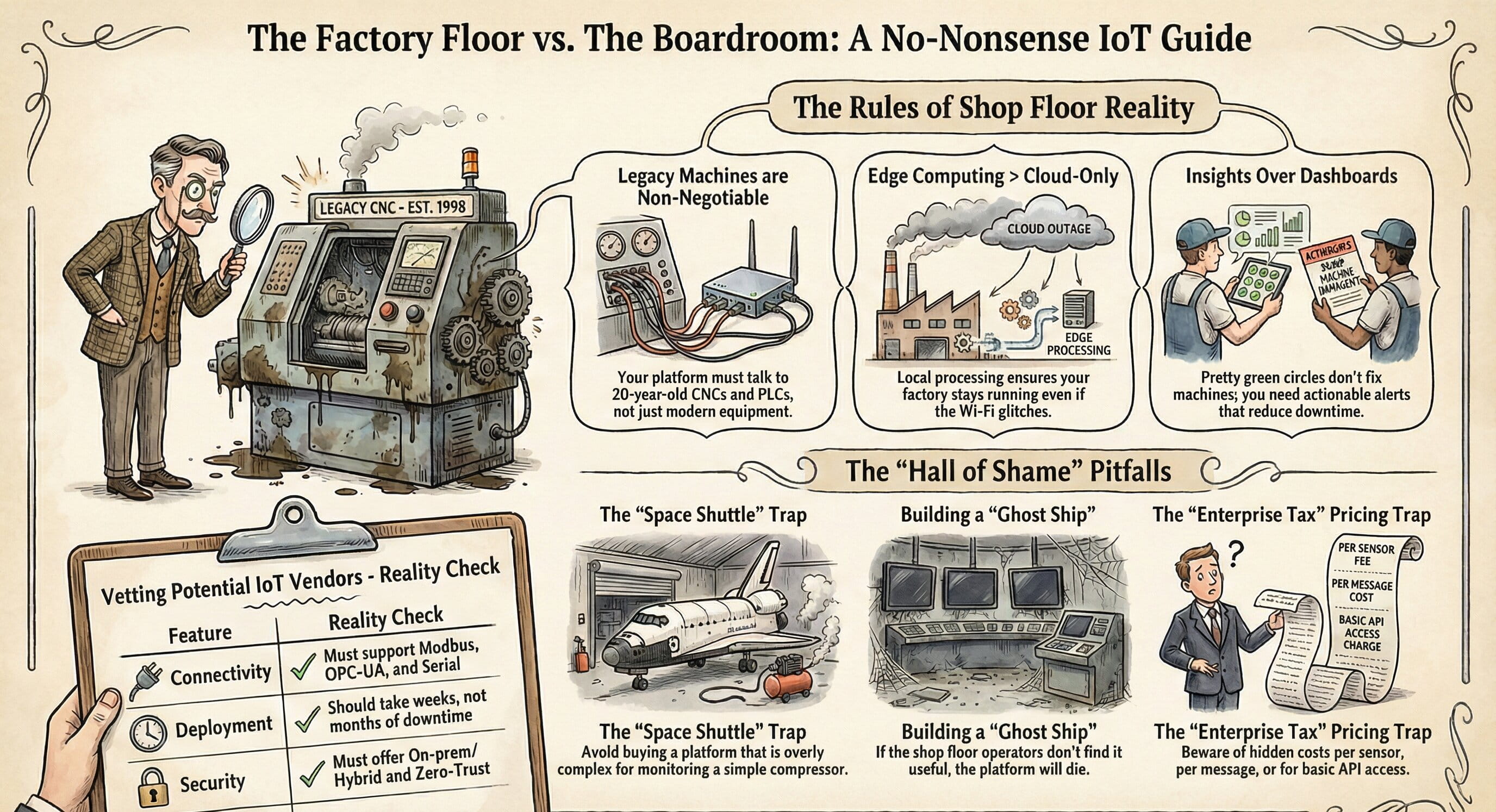
The “Demo vs. Shop Floor” Reality Check
Most IoT platforms look spectacular in a climate-controlled boardroom. They arrive with sleek dashboards, dark-mode interfaces, digital twin visuals, and enough AI language to make every slide feel futuristic. But manufacturers do not run production in presentation mode. The real question is whether the platform still works when it meets oil, vibration, metal dust, mixed protocols, intermittent connectivity, and a 20-year-old CNC machine.
Choosing an IoT platform is no longer a nice-to-have IT initiative. It is a business survival decision tied directly to downtime, energy performance, labor productivity, cybersecurity, and long-term competitiveness. Manufacturers across Europe and Germany are being squeezed by rising energy costs, a projected shortage of skilled workers, and the reality of GDPR and EU Green Deal compliance.
If you have ever sat through a vendor presentation and wondered whether the technology would actually survive your factory environment, that instinct is healthy. Most projects do not fail because of sensors. They fail because of a fundamental mismatch between software designed for innovation theater and the realities of a factory still operating on what many would honestly call Industry 2.5.
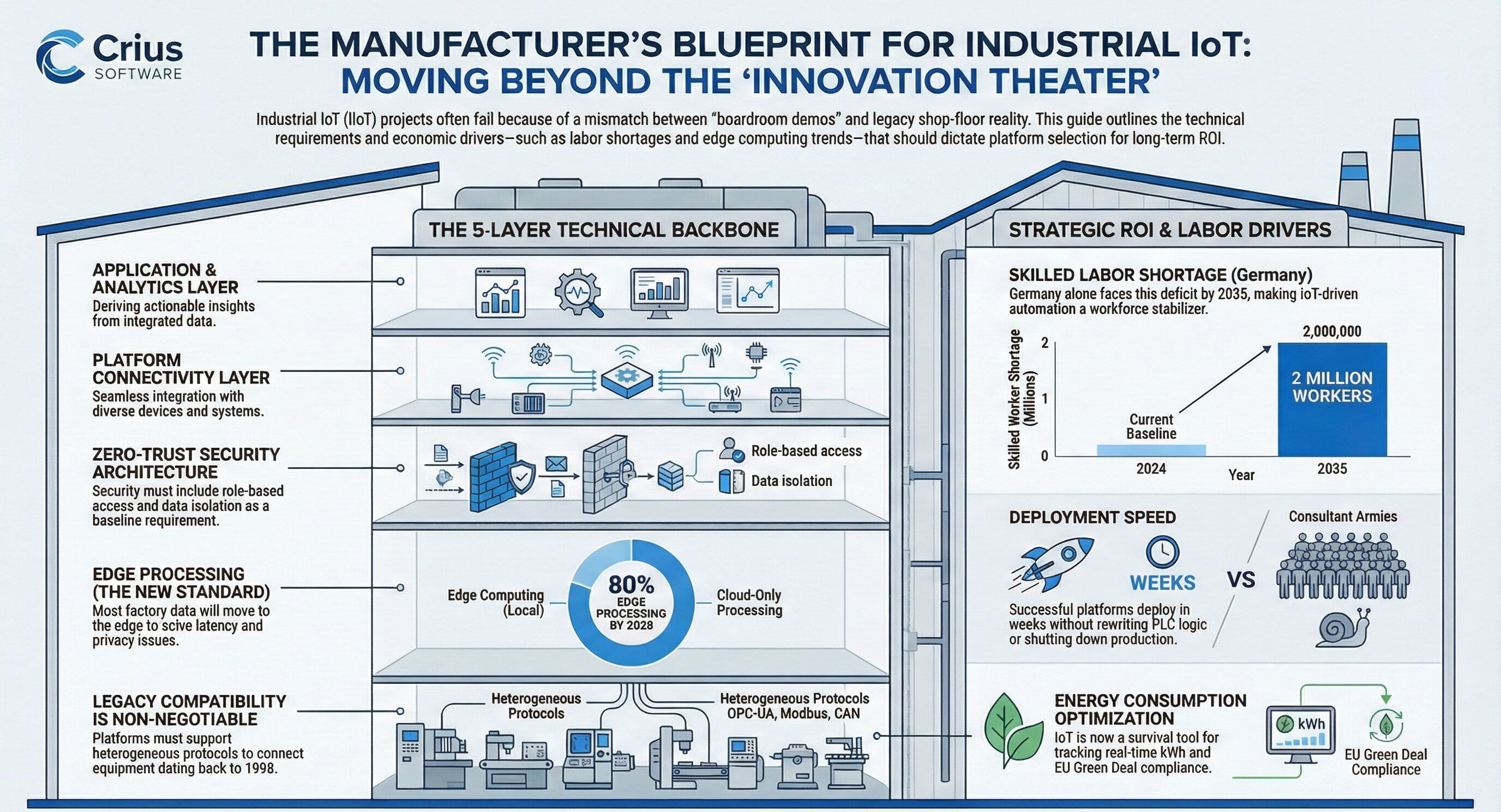
Executive summary visual
For quick stakeholder alignment, use this summary visual to anchor the conversation around business fit, technical viability, and deployment realism before engaging vendors in detailed architecture discussions.
Part I: The 10 Unbreakable Rules of Industrial IoT
To avoid the innovation-theater trap, every platform under evaluation should be forced through ten non-negotiable rules. If it fails any of them, it should not make the shortlist.
Rule 1: Start with Problems, Not Platforms
Do not begin by asking which platform is “best.” Start by identifying the operational bottlenecks bleeding money from the business—unplanned downtime, OEE leakage, quality instability, energy spikes, delayed root-cause analysis, or inconsistent traceability.
Rule 2: Legacy Hardware Is Non-Negotiable
Your factory is rarely greenfield. It is a layered environment of Siemens, Fanuc, Mitsubishi, serial devices, older PLCs, and machines from different investment eras. The platform must handle the reality you already own.
Rule 3: Edge Computing Beats Cloud-Only Thinking
In industrial environments, three seconds of latency can be operationally unacceptable. If the internet blips, production should not lose alerts, buffering, or local intelligence.
Rule 4: Insights Matter More Than Dashboards
Dashboards are not outcomes. Manufacturers do not need more screens to stare at; they need systems that identify what is wrong, who needs to act, and what the likely root cause is.
Rule 5: Practical AI Beats Hype AI
If a vendor is promising fully autonomous self-healing factories overnight, protect your budget. Industrial AI should solve a narrow, high-value problem first and remain explainable to the people using it.
Rule 6: Security Is Baseline, Not Premium
Industrial cyberattacks are a production and business-continuity threat. Security should never appear as a premium feature upgrade.
Rule 7: Avoid Vendor Lock-In
Freedom is part of the value proposition. Your data belongs to your business, not to the platform vendor.
Rule 8: Pricing Must Stay Transparent at Scale
Many platforms look affordable in pilot mode and become punishingly expensive once machine count, data traffic, dashboards, or API usage expands.
Rule 9: Deployability Determines Real Value
If implementation needs an army of consultants, major downtime, or PLC rewrites just to expose one line’s OEE, the platform is already failing the business case.
Rule 10: Support and Ecosystem Are Part of the Product
At 2:00 AM, when a line goes down or a pilot starts behaving unpredictably, the software alone is not the solution. The platform is only as strong as the people and ecosystem behind it.
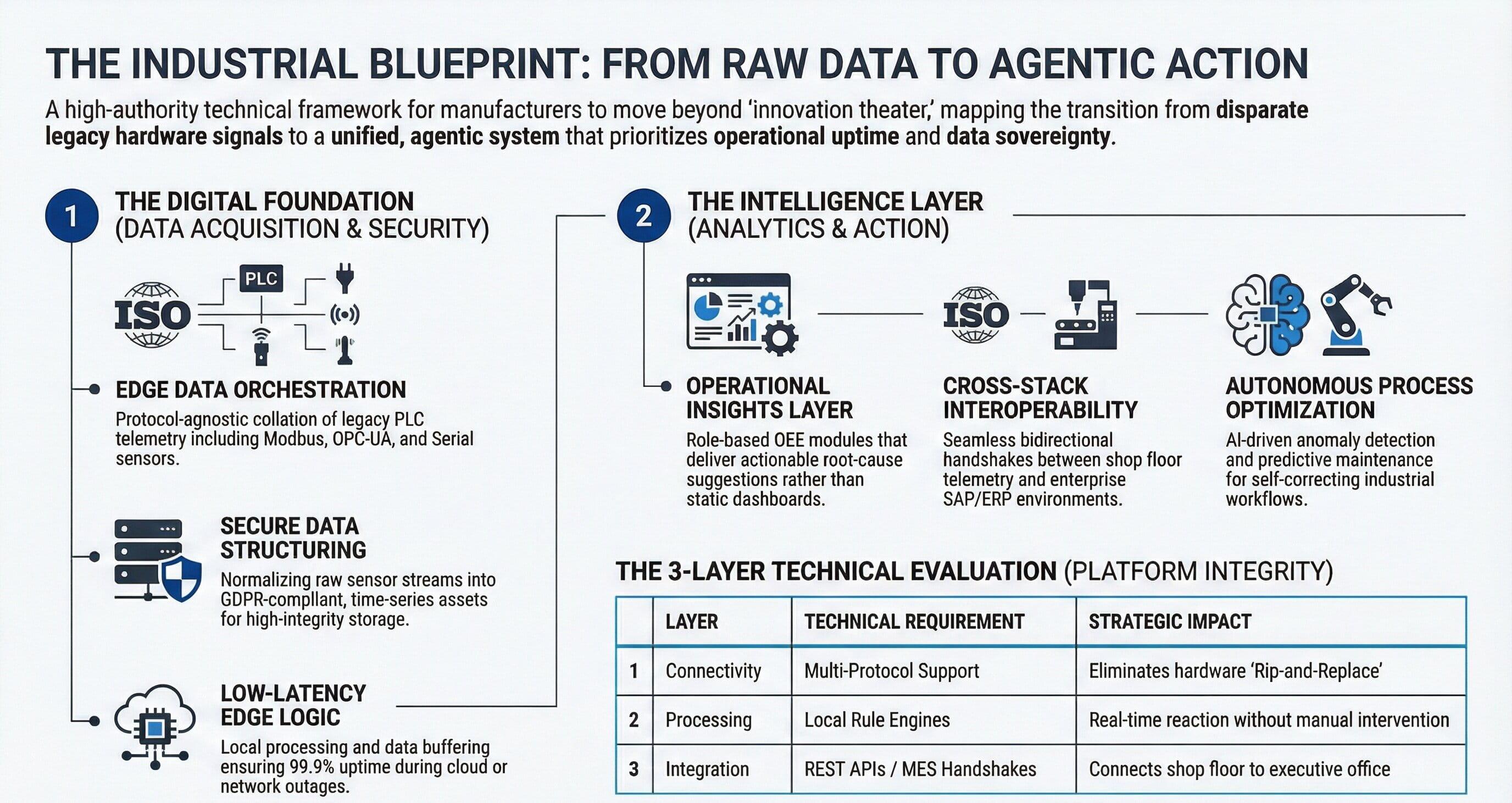
From industrial data to agentic action
Platform selection should not end at connectivity. The real objective is to convert operational data into timely, explainable, and governed action across production, maintenance, quality, and leadership workflows.
Part II: The 7-Step Selection Framework
Once the rules are clear, manufacturers need a repeatable sequence for filtering out noise, comparing vendors, and protecting the scaling path. This framework helps move the organization from searching to scaling.
Step 3 in Focus: The 5-Layer Technical Evaluation
This is the point where platform architecture stops being abstract. The following five layers determine whether the platform can survive real manufacturing complexity and connect operational data to business outcomes.
| Layer Name | Key Requirements | Why It Matters |
|---|---|---|
| 1. Connectivity | OPC-UA, MQTT, Profinet, CAN, Modbus, Serial, Edge Gateways | If it cannot talk to legacy equipment and mixed-age assets, the project can fail on Day 1. |
| 2. Data Management | Time-series databases, normalization, GDPR-compliant storage | This layer turns messy raw sensor feeds into structured and usable business data. |
| 3. Processing | Rule engines, real-time alerts, low-code workflows | It enables the system to react to events without waiting for manual intervention. |
| 4. Applications | OEE modules, energy monitoring, Asset Administration Shell (AAS) | This is where operational value appears and compliance documentation becomes usable. |
| 5. Integration | SAP/ERP connectors, MES handshakes, REST APIs | It prevents siloed data and connects the shop floor to enterprise decision-making. |
Part III: 10 “Truth Bomb” Mistakes
Manufacturers do not just need to know what good looks like. They also need to recognize the patterns that repeatedly destroy platform value before scale is ever reached.
1. The Space Shuttle Trap
Buying a platform far too complex for the actual problem, such as using an overengineered ecosystem to monitor a simple compressor.
2. Dashboard Obsession
Believing that attractive charts fix operational issues. They do not. Machines improve when action improves.
3. Building a Ghost Ship
Ignoring operators and shop-floor users. If they do not adopt it, the platform is functionally dead.
4. The “Integration Is Easy” Lie
Integration is never easy. It only becomes manageable with sound architecture, realistic scope, and disciplined design.
5. The Change Management Blind Spot
Platforms rarely fail alone. Adoption collapses when teams forget to budget for training, ownership, and operating model change.
6. Ownership Limbo
If IT, OT, and Production all “sort of” own the platform, then in practice no one owns it.
7. Boiling the Ocean
Trying to digitize the entire factory at once instead of proving value on one line and scaling with evidence.
8. The Wi-Fi Pipe Dream
Assuming standard office-grade networking will survive industrial conditions. It will not.
9. The Cloud-Only Trap
Treating cloud as the only modern answer, when hybrid architectures are often the practical reality for European manufacturing security and resilience.
10. Data Hoarding
Collecting data endlessly without decision logic. IoT exists to improve action, not to build a digital landfill.
The No-Nonsense Checklist for Your Next Vendor Meeting
- [ ] Does it work with both legacy machines (Modbus, Serial, CAN) and newer ones (OPC-UA, Profinet)?
- [ ] Can it continue operating offline at the edge if cloud connectivity drops?
- [ ] Is it secure by design, with on-premise or hybrid options and firewall-friendly architecture?
- [ ] Is the pricing transparent, without per-message or per-dashboard traps?
- [ ] Can a pilot be deployed in weeks without rewriting PLC logic?
- [ ] Does it include industry-specific templates and active customer success support?
- [ ] Is it compatible with the Asset Administration Shell (AAS) for future standardization?
Looking Ahead: Trends That Actually Matter
These are not novelty trends. They are the developments likely to shape competitiveness, compliance, and architecture priorities across European manufacturing in the years ahead.
AI as Guesswork Replacement
Manufacturers are moving from intuition-led diagnosis toward anomaly detection, predictive maintenance, and increasingly autonomous process optimization.
Digital Twins as Compliance Tools
Digital twins are becoming instruments for root-cause analysis, traceability, and EU Green Deal reporting rather than purely visual showcase assets.
Standardization Through AAS
The Asset Administration Shell is emerging as a backbone of European interoperability. Platforms that resist it risk becoming tomorrow’s legacy stack.
Edge Dominance
By 2028, most factory data processing is expected to move closer to the machine in order to reduce latency, strengthen privacy, and control cloud cost.
Conclusion & Final Directive
The platform must fit the factory, not the other way around. Every facility has its own mix of machine generations, workflows, people, cybersecurity constraints, and improvement priorities. Your digital backbone should reflect that reality instead of imposing a generic software worldview on production.
This is not a short-term tooling choice. It is a decision that can shape the next decade of production efficiency, resilience, and standardization readiness. Do not be distracted by innovation theater. Choose a partner that respects shop-floor conditions, protects data sovereignty, integrates cleanly with the business, and remains relentlessly focused on operational ROI.
Ready to cut through the vendor fluff?
If you want a tailored IoT platform shopping checklist or a focused consultation to evaluate your current technology stack against these rules, use this article as your starting point for the next vendor conversation—and make every answer prove real factory readiness.
Review the board-ready full reportEnhanced Full Blog Text — Board-Ready Report Format
How to Choose the Right IoT Platform: A No-Nonsense Guide for Manufacturers
Executive Summary. Most industrial IoT platform decisions fail long before implementation because organizations buy what performs well in a demonstration instead of what performs well on a real factory floor. The central issue is fit: fit with legacy hardware, fit with plant latency requirements, fit with European security and data sovereignty needs, and fit with the operational metrics the business is trying to improve. This report provides a direct decision lens for manufacturers, especially in Europe and Germany, by laying out the reality check, the 10 unbreakable rules of industrial IoT platform selection, a practical 7-step evaluation framework, the 5-layer technical model, the most common selection failures, and the trends that genuinely matter for future competitiveness.
1. The “Demo vs. Shop Floor” Reality Check
Most IoT platforms look spectacular in a climate-controlled boardroom. They feature sleek dark-mode interfaces, spinning 3D digital twins, and enough “AI” buzzwords to choke a horse. But the painful truth is that those platforms can become expensive paperweights the second they smell oil, metal shavings, and a 20-year-old CNC machine.
Choosing an IoT platform is no longer a “nice-to-have” IT project; it is a business survival decision. Manufacturers—especially in Europe and Germany—are being squeezed by a perfect storm: skyrocketing energy costs, a projected shortage of 2 million skilled workers by 2035, and the iron fist of GDPR and EU Green Deal compliance.
If you have sat through vendor PowerPoints wondering whether the technology will actually work on your floor, trust your gut. Most projects fail not because of the sensors, but because of a fundamental mismatch between “innovation theater” software and the gritty reality of a factory running on Industry 2.5.
The industrial truth bomb is simple: most IoT projects fail because manufacturers pick a platform that fits a PowerPoint slide rather than their factory floor. Pretty charts don’t fix broken machines, and factory Wi-Fi cannot carry a digital transformation. If the platform does not respect your legacy hardware, it is just a hobby.
2. Part I: The 10 Unbreakable Rules of Industrial IoT
To avoid the innovation-theater trap, every platform under evaluation must survive ten practical rules.
Rule 1: Start with Problems, Not Platforms. Do not ask which platform is “best.” Ask which operational bottlenecks—such as unplanned downtime, OEE leakage, or energy spikes—are bleeding you dry. Must do: tie every use case to a business metric, for example, “Reduce peak load to avoid utility penalties.” Red flag: a vendor who talks about features before asking about your shop-floor bottlenecks.
Rule 2: Legacy Hardware Is Non-Negotiable. Your factory is a museum of Siemens, Fanuc, Mitsubishi, and machines from the Clinton administration. Your platform must handle this mess. Must do: require native support for OPC-UA, Modbus, MQTT, Profinet, CAN, and Serial. Red flag: salespeople who say, “You’ll need to upgrade your PLC hardware to work with our cloud.”
Rule 3: Edge Computing Is Better Than Cloud-Only. In a factory, a three-second latency is an eternity. If your internet blips, your production should not. Must do: require local processing, data buffering, and firewall-friendly architecture that works offline. Red flag: any system where a cloud outage stops your local alerts or data collection.
Rule 4: Insights Matter More Than Dashboards. Dashboards are just telescopes. You do not need more screens to look at; you need intelligence that tells you what to fix. Must do: actionable alerts and role-based views that distinguish between an operator and a plant manager. Red flag: a platform that prioritizes pretty green circles over root-cause suggestions.
Rule 5: Practical AI Beats “Hype AI.” If a vendor starts talking about fully autonomous, self-healing factories, check your wallet and show them the door. Must do: AI that solves real problems, such as anomaly detection or explainable predictive maintenance. Red flag: claims that “Our AI will reinvent your factory overnight” without human input.
Rule 6: Security Must Be Zero-Trust and GDPR-Aware. Industrial cyberattacks are a survival threat. Security is a baseline requirement, not a premium add-on. Must do: on-premise or hybrid deployment options, encrypted communication, and full audit logs. Red flag: a vendor who cannot explain data sovereignty or firewall-friendly architecture in three minutes.
Rule 7: Avoid Vendor Lock-In. Freedom is a feature. Your data belongs to you, not the software company. Must do: open standards, exportable data, and modular architecture. Red flag: proprietary devices that only work with one specific platform.
Rule 8: Demand Transparent Pricing. Watch for creative pricing that punishes you for succeeding. Must do: fixed pricing or tiered, site-based licenses. Red flag: the enterprise tax—charging per message, per dashboard, per sensor, or for basic API access.
Rule 9: Prioritize Deployability. If implementation requires an army of consultants and six months of downtime, it is a failure before it starts. Must do: deploy in days or weeks without rewriting existing PLC logic. Red flag: requirements for massive digital transformation teams just to see OEE on one line.
Rule 10: Evaluate Support and Ecosystem. A platform is only as good as the people standing behind it when a line goes down at 2:00 AM. Must do: industry-specific templates and proactive customer success involvement. Red flag: self-service-only platforms that offer no manufacturing-specific guidance or onboarding.
3. Part II: The 7-Step Selection Framework
Once you understand the rules, you need a repeatable process to filter out the noise. The right sequence helps move the organization from vague searching to structured scaling.
Step 1: Define Use Cases. Identify specific problems like OEE tracking, energy optimization, or quality traceability.
Step 2: Map the OT/IT Landscape. Document machine ages, protocols such as Profinet and Modbus, and your current cybersecurity posture.
Step 3: Run the 5-Layer Technical Evaluation. Use a structured technical model to vet the integrity of the stack.
Step 4: Check Scalability and Licensing. Get a written quote for what happens when you move from 10 machines to 500.
Step 5: Validate European-Grade Security. Ensure alignment with ISO 27001 thinking and GDPR data sovereignty expectations.
Step 6: Execute the “Real Factory Pilot.” Never buy from a demo. Test connectivity on your most difficult machine.
Step 7: Compare TCO vs. ROI. Evaluate the three-year horizon, including integration and training costs, instead of only the initial license discussion.
Step 3 in detail: The 5-Layer Technical Evaluation. The five layers are as follows. Layer 1: Connectivity requires OPC-UA, MQTT, Profinet, CAN, Modbus, Serial, and Edge Gateways, because if the platform cannot talk to your legacy junk, the project dies on Day 1. Layer 2: Data Management requires time-series databases, normalization, and GDPR-compliant storage, because this turns messy raw sensor data into structured, usable business assets. Layer 3: Processing requires rule engines, real-time alerts, and low-code workflows, because it enables the system to react to events without manual intervention. Layer 4: Applications requires OEE modules, energy monitoring, and Asset Administration Shell compatibility, because that is where the actual work gets done and compliance is documented. Layer 5: Integration requires SAP or ERP connectors, MES handshakes, and REST APIs, because those prevent data silos and connect the shop floor to the executive office.
4. Part III: 10 “Truth Bomb” Mistakes
Manufacturers should also recognize the classic mistakes that repeatedly undermine industrial IoT programs.
1. The Space Shuttle Trap: buying a platform that is far too complex for monitoring a simple compressor.
2. Dashboard Obsession: thinking pretty charts fix machines. They do not.
3. Building a Ghost Ship: ignoring operators. If the floor team does not use it, the platform is dead.
4. The “Integration Is Easy” Lie: integration is never easy; it only becomes manageable with the right architecture.
5. The Change Management Blind Spot: platforms do not fail, but adoption does if you do not budget for training.
6. Ownership Limbo: if IT, OT, and Production all sort of own it, then no one owns it.
7. Boiling the Ocean: starting with the whole factory at once. Start with one line, prove ROI, then scale.
8. The Wi-Fi Pipe Dream: your standard office router will not save you. Industrial environments need robust connectivity.
9. The Cloud-Only Trap: assuming the cloud is the only answer. In Europe, hybrid is the practical reality for security.
10. Data Hoarding: collecting data for the sake of data. IoT is about making decisions, not building a digital landfill.
5. The No-Nonsense Checklist for Your Next Vendor Meeting
The practical checklist is direct. Ask whether the platform works with both legacy machines—using Modbus, Serial, and CAN—and newer ones using OPC-UA and Profinet. Ask whether it can operate offline at the edge if the cloud connection drops. Ask whether it is secure by design, with on-premise or hybrid options and firewall-friendly architecture. Ask whether pricing is transparent, with no per-message or per-dashboard charges. Ask whether a pilot can be deployed in weeks without rewriting PLC logic. Ask whether industry-specific templates and active customer success support are included. Finally, ask whether the platform is compatible with the Asset Administration Shell for future standardization.
6. Looking Ahead: Trends That Actually Matter
These are not cool-tech distractions; they are the requirements that will increasingly matter for competitiveness in Europe.
AI as Guesswork Replacement. The direction is moving from “I think the machine is vibrating” to more autonomous process optimization.
Digital Twins as Compliance Tools. Digital twins are not just for pretty models; they are becoming important for root-cause analysis and EU Green Deal reporting.
Standardization through AAS. The Asset Administration Shell is becoming the backbone of European interoperability. If your platform fights it, you are buying a legacy system.
Edge Dominance. By 2028, 80% of factory data will be processed at the edge to reduce latency and privacy costs.
7. Conclusion & Final Directive
The platform must fit the factory, not the other way around. Every factory, machine, and workflow is unique; your digital backbone should reflect that reality. This decision will shape the next decade of your production efficiency. Do not be blinded by innovation theater. Choose a partner that respects your shop-floor reality, protects your data sovereignty, and focuses entirely on operational ROI.
8. Call to Action
Ready to cut through the vendor fluff? If you want a tailored IoT platform shopping checklist or a 30-minute consultation to evaluate your current tech stack against these rules, just comment “READY” or say “Let’s do it.” The next step is to convert this framework into a vendor evaluation process designed for your specific environment.
Raj updated on 17 Feb 2026, 09:05AM
This is one of the few pieces on IoT platforms that actually reflects plant reality. The point about vendors optimizing for demo environments rather than mixed-age production assets is exactly where many teams get trapped.Lena updated on 17 Feb 2026, 10:42AM
Agreed. We evaluated two platforms last year and both looked impressive until we asked about serial connectivity and offline buffering. That was the moment the conversation changed.Markus updated on 17 Feb 2026, 01:18PM
The “start with problems, not platforms” advice should be mandatory. Too many initiatives begin with architecture discussions before anyone defines the operational loss they are trying to reduce.Priya updated on 17 Feb 2026, 03:01PM
Yes, and once the business metric is explicit, platform evaluation becomes much easier. If the target is downtime reduction or energy peak avoidance, you stop being distracted by superficial features.Daniel updated on 18 Feb 2026, 08:12AM
The edge-versus-cloud section is particularly relevant for regulated manufacturers in Europe. We still see teams assuming cloud-first is automatically modern, when in practice hybrid is often the more resilient model.Anika updated on 18 Feb 2026, 11:26AM
What stood out to me was the warning on transparent pricing. We were quoted attractively at pilot stage, but the scale-up economics changed completely once message volume and dashboard access were added.Ethan updated on 18 Feb 2026, 12:14PM
That is a recurring issue. Procurement needs a written model for 10, 100, and 500 machines before any pilot starts, otherwise the total cost picture is incomplete.Vikram updated on 19 Feb 2026, 09:47AM
The 5-layer technical evaluation is useful because it forces a proper architecture conversation. Connectivity, storage, processing, applications, and enterprise integration are usually discussed in isolation, which creates blind spots later.Sophie updated on 19 Feb 2026, 11:05AM
Exactly. We learned that the hard way when our first pilot collected data successfully but had no reliable MES and ERP integration path, so the information never reached planning teams.Tobias updated on 19 Feb 2026, 02:31PM
The section on operator adoption is understated but critical. If the people on shift do not trust the alerts or see workflow relevance, the platform may be technically sound and still fail commercially.Neha updated on 20 Feb 2026, 08:55AM
I also appreciated the mention of AAS. Interoperability is no longer theoretical for European industry. Decisions made now will affect how painful future standardization efforts become.Julian updated on 20 Feb 2026, 04:22PM
The “Wi-Fi pipe dream” line made me smile because it is true. Office network assumptions do not survive around metal structures, interference, and harsh industrial conditions.Meera updated on 20 Feb 2026, 05:40PM
And when connectivity is unstable, the value of local buffering and edge logic becomes immediately obvious. That should be part of every pilot acceptance criterion.Felix updated on 21 Feb 2026, 10:10AM
Strong article. The biggest takeaway for me is that platform fit is less about who has the most features and more about who can connect, secure, scale, and support a messy real-world environment without forcing a factory rewrite.