
1) The Industrial Reality Check: A $2M Paperweight at 3:00 AM
It is 3:00 AM in a Tier-2 automotive stamping plant in Querétaro, Mexico. The Plant Manager is staring at a high-definition, 85-inch dashboard—purchased during a “Digital Transformation” fever dream in 2024—that is currently glowing a serene, mocking blue. The screen says “System Operational,” but Line 4 has been down for six hours because a legacy PLC decided to stop talking to a cloud platform designed by people who have never stepped foot on a shop floor.
Back at headquarters in Stuttgart or Detroit, the “Digital Excellence” team is celebrating. They’ve successfully “digitalized” three machines in a controlled lab environment. They call it a success. The P&L, however, calls it a disaster.
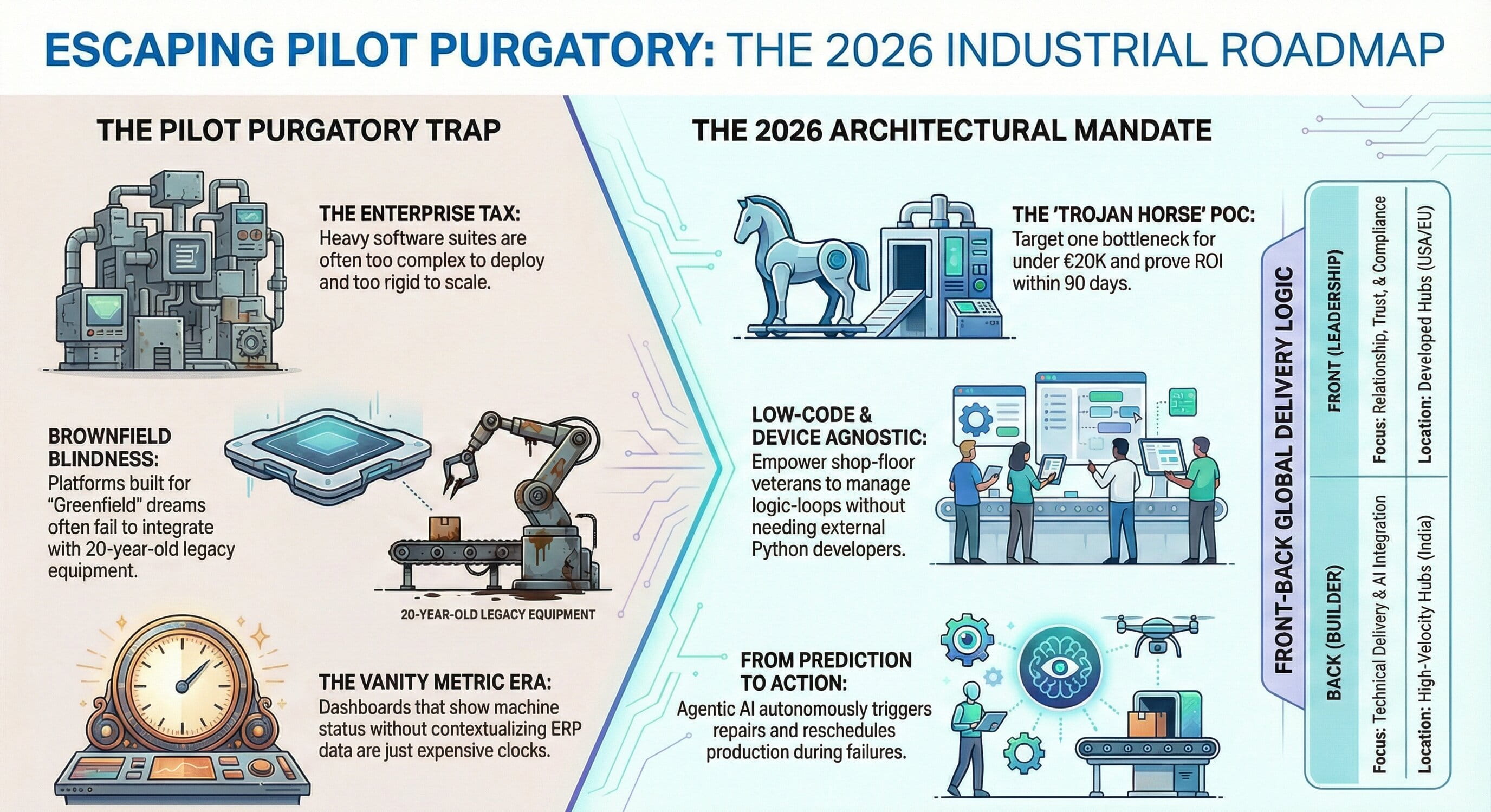
2) The “Enterprise Tax”: Why the Industrial Sledgehammer Breaks Mid-Market Rollouts
The global industrial software market is dominated by behemoths offering “integrated stacks.” For a Fortune 50 company with a €500M digital budget, these work—sort of. For the global mid-market, they are structurally unsustainable.
| What you bought | What you needed | What to ask |
|---|---|---|
| A toolkit + integrator dependency | A platform that configures in-hours | “Who can change thresholds without Python?” |
| Greenfield assumptions | Brownfield device agnosticism | “Can you connect to 1998 assets without proprietary gateways?” |
| A dashboard of symptoms | A thread from machine → MES/ERP | “Can telemetry predict order impact automatically?” |
3) The 2026 Architectural Mandate: Low-Code, Device-Agnostic, API-First
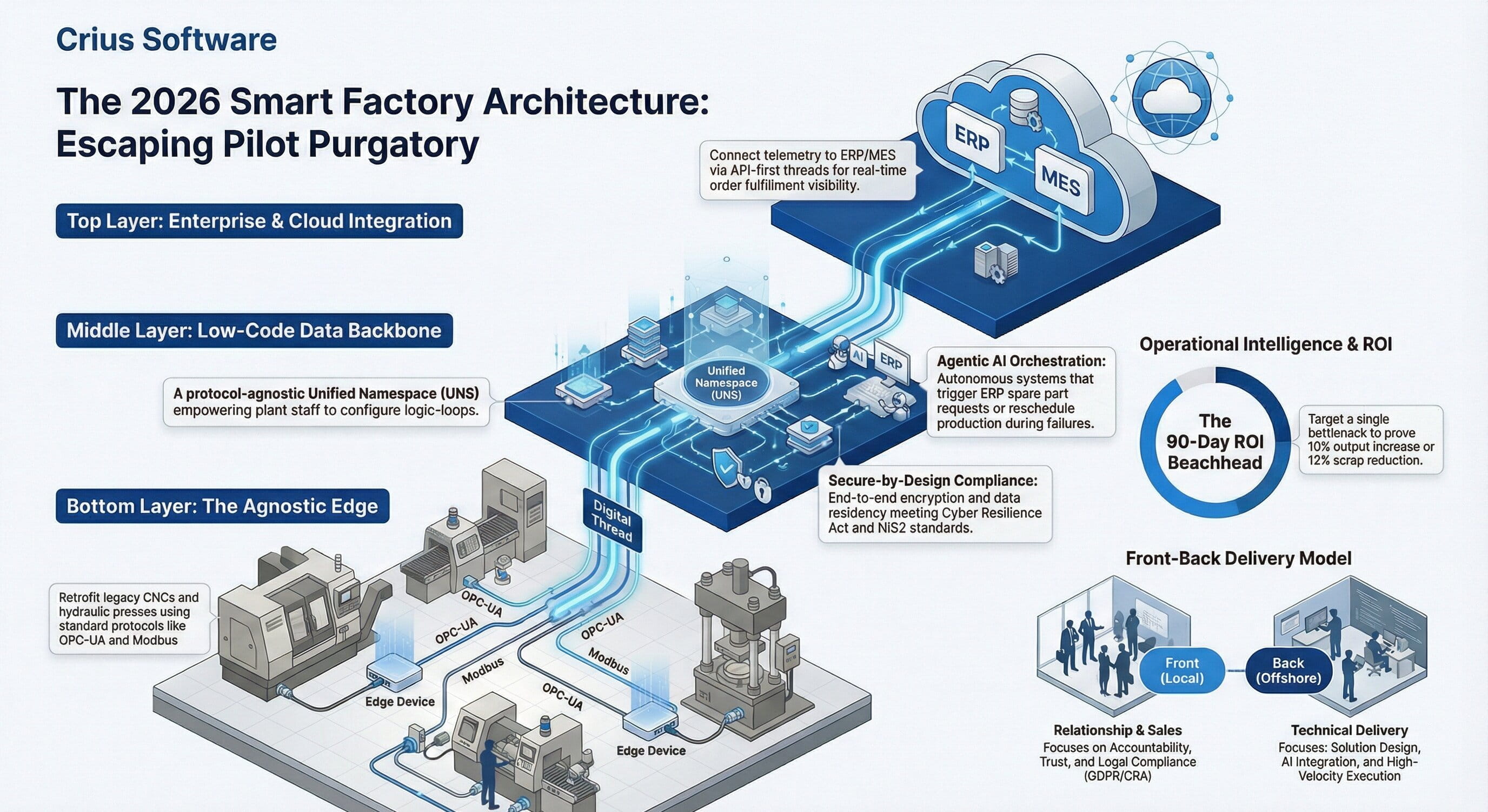
To survive the current “OEM Squeeze,” where customers demand real-time transparency and carbon data (CBAM), your architecture must meet three non-negotiable technical standards.
4) Beyond Prediction: The Rise of Agentic AI
In 2024, the industry buzzword was “Predictive Maintenance.” By 2026, we have moved to Agentic AI. Predicting a failure is useless if you don’t have personnel to act on the alert. Agentic AI doesn’t just “show” an anomaly; it acts to resolve it within defined constraints.
5) The Global-Efficiency Delivery Logic: Front-Back Strategy
The most successful industrial models in 2026 utilize a Front-Facing Leadership + Behind-the-Scenes Builder framework to keep operational costs low while ensuring high-quality delivery. This model solves the trust gap: customers get local accountability and compliance alignment, while heavy technical lifting is executed efficiently offshore.
| Segment | Role | Focus | Location |
|---|---|---|---|
| Front | Relationship & Sales | Local accountability, trust, legal compliance | Developed hubs (e.g., Germany, USA) |
| Back | Technical delivery | Solution design, AI integration, offshore execution | High-velocity hubs (e.g., India) |
6) Regulatory Compliance as a Competitive Edge
In 2026, global manufacturing is a legal minefield. Industrial devices are networked nodes that must be secure-by-design. Data residency tensions (cloud efficiency vs. sovereignty) require hybrid capability: sensitive production data on-premise, global analytics in the cloud—without breaking governance.
7) The “Trojan Horse” Strategy: Prove ROI Fast, Then Scale
The era of the €1M “Big Bang” implementation is dead. For the mid-market, the sane path is a PoC beachhead: start small, prove ROI quickly, and only then scale across plants.
8) Technical Decision-Maker’s Framework: 7 Brutal Questions
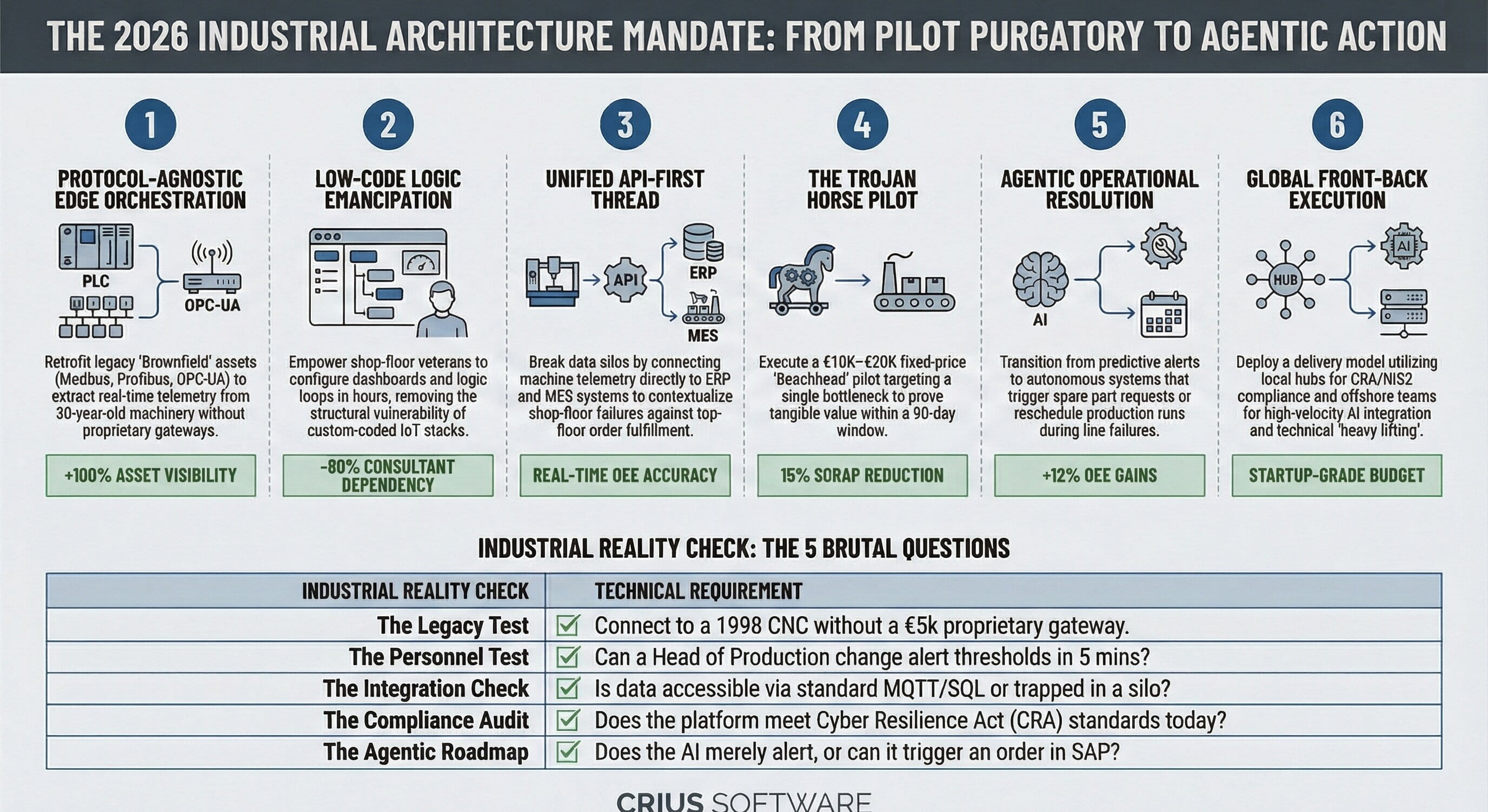
If you are evaluating your path out of Pilot Purgatory, put your current vendor through this industrial reality check:
- The Legacy Test: Can your platform talk to a 1998 CNC machine without a proprietary, €5,000 gateway?
- The Personnel Test: Can my Head of Production change an alert threshold in 5 minutes without calling a Python developer?
- The Integration Check: Is your data trapped in a proprietary “Cloud OS,” or accessible via standard MQTT/SQL for my ERP?
- The Delivery Model: Are you charging Western hourly rates for routine maintenance that AI/offshore teams can do at 1/5th the cost?
- The Compliance Audit: Does the platform meet NIS2 and Cyber Resilience Act standards today?
- The PoC Reality: Will you commit to a fixed-price pilot that solves a real production bottleneck in 8 weeks?
- The Agentic Roadmap: Does your AI merely “alert,” or can it autonomously trigger a maintenance order in SAP?
9) Conclusion: The Board-Level Interpretation
For the C-suite, the conclusion is simple: the top-down digital transformation model is structurally unsustainable for the global mid-market. Success in 2026 is driven by pragmatic innovation: start small, prove ROI quickly, and use a global delivery model to keep operational costs tiny while scaling authority across the shop floor.
The foundational design decisions behind your platform strategy will determine if you are building an asset or a long-term liability. If you are evaluating how to scale beyond isolated pilots—or struggling with fragmented industrial data architecture—these choices deserve scrutiny far beyond a glossy brochure.
Enhanced Full Blog Text (Board-Ready Report Format)
Executive summary. Global manufacturers are increasingly trapped in Pilot Purgatory—a state where digitalization “works” in controlled environments but fails at the first live deployment. The reason is structural: mid-market operations are forced to pay an Enterprise Tax for stacks that are too complex to deploy, too rigid to scale, and too blind to brownfield heterogeneity. In 2026, the only viable path is pragmatic innovation: prove ROI on one critical machine fast, then scale via a low-code, device-agnostic, API-first backbone that enables agentic workflows and compliance-by-design.
It is 3:00 AM in a Tier-2 automotive stamping plant in Querétaro, Mexico. The Plant Manager is staring at a high-definition, 85-inch dashboard—purchased during a “Digital Transformation” fever dream in 2024—that is currently glowing a serene, mocking blue. The screen says “System Operational,” but Line 4 has been down for six hours because a legacy PLC decided to stop talking to a cloud platform designed by people who have never stepped foot on a shop floor.
Back at the headquarters in Stuttgart or Detroit, the “Digital Excellence” team is celebrating. They’ve successfully “digitalized” three machines in a controlled lab environment. They call it a success. The P&L, however, calls it a disaster.
This is the standard state of the global manufacturing mid-market in 2026. You are stuck in Pilot Purgatory—a state where you have enough data to be dangerous but not enough to be profitable. You’ve spent millions on a “Grand Strategy” pushed by a vendor with a stadium named after them, only to realize that their software is a “sledgehammer to crack a nut”. If you are a mid-market leader or a supplier to an OEM like BMW or Boeing, your “Hidden Champion” status doesn't protect you from the Enterprise Tax: the astronomical cost of software that is too complex to deploy and too rigid to scale.
The global industrial software market is dominated by behemoths offering “integrated stacks”. For a Fortune 50 company with a €500M digital budget, these work—sort of. For the global mid-market, they are structurally unsustainable.
The Consultancy Trap. Most legacy platforms are actually “toolkits.” You pay for the license, then spend 5x that amount on integrators to make it work with your 20-year-old machines. These integrators thrive on complexity; they want your implementation to take 24 months because that is 24 months of billable hours. For a mid-sized manufacturer, a 2-year implementation cycle is a death sentence in a market where margins are squeezed by rising energy costs and global tariffs.
The Brownfield Blindness. These platforms are built for “Greenfield” dreams—factories that exist only in PowerPoint. They struggle with the “Brownfield” reality of heterogeneous equipment: Modbus, Profibus, and sensors held together by hope. When a vendor tells you to “simply upgrade your PLCs” to talk to their cloud, they aren't offering a solution; they are offering a capital expenditure request that your CFO will rightly laugh out of the room.
The Vanity Metric Era. Dashboards are not digitalization. If your system tells you a machine is down but can't tell you why in the context of your ERP's order fulfillment, you haven't bought a solution; you’ve bought a very expensive clock. In 2026, the cost of the “Digital Transformation” cannot exceed the operational savings it generates. Anything else is just expensive theater.
To survive the current “OEM Squeeze,” where customers demand real-time transparency and carbon data (CBAM), your architecture must meet three non-negotiable technical standards.
I. Low-Code Emancipation. The global talent drought is no longer a “risk”—it is a foundational constraint. You cannot hire enough data scientists or Python developers to manage a complex, custom-coded IoT stack. The only way to scale is to empower your existing workforce: the production engineers and plant managers who actually understand the vibration patterns of a 1995 CNC machine. Your platform must be a low-code environment where a shop-floor veteran can configure a dashboard or a logic-loop in hours. If the “digital brains” of your company are locked in the heads of two external consultants, your company is architecturally fragile.
II. Absolute Device Agnosticism. A Smart Factory strategy that requires buying new machines is a shopping list, not a strategy. A modern data backbone must be protocol-agnostic, capable of retrofitting legacy assets—whether they speak OPC-UA, Modbus, or MTConnect—and extracting “Board-ready” KPIs immediately. Consider the mathematical reality of Overall Equipment Effectiveness (OEE): OEE = Availability × Performance × Quality. If your data architecture cannot pull these three variables in real-time from a 30-year-old hydraulic press without a €10,000 proprietary gateway, your OEE calculation is a guess, and your “Smart Factory” is a lie.
III. API-First Integration (Top-Floor to Shop-Floor). If your IIoT platform exists in a silo, it is a liability. Real value is found in the Digital Thread: connecting machine telemetry directly to Enterprise Resource Planning (ERP) and Manufacturing Execution Systems (MES). When a machine fails in Vietnam, the sales team in New York should know the impact on the order fulfillment cycle before the customer even gets an automated shipping delay notification.
In 2024, the industry buzzword was “Predictive Maintenance”. By 2026, we have moved to Agentic AI. Predicting a failure is useless if you don't have the personnel to act on the alert. Agentic AI doesn't just “show” an anomaly; it acts to resolve it within defined operational constraints: Autonomous Workflows: Instead of sending a frantic email to a busy supervisor, an Agentic system autonomously triggers a spare part request in the ERP when it detects a bearing temperature spike. Dynamic Rescheduling: If a line goes down, the AI cross-references the current order book and reschedules the high-priority runs to a different facility in real-time. Energy Arbitrage: In high-cost regions like the EU, Agentic AI can adjust machine duty cycles based on real-time energy price fluctuations, ensuring that power-heavy processes run when rates are lowest. This isn't “next-gen” hype; it is a structural necessity for firms operating with lean local teams who cannot afford to spend their days staring at “Heatmaps” and “Gantt Charts”.
The most successful industrial models in 2026 utilize a Front-Facing Leadership + Behind-the-Scenes Builder framework to maintain low operational costs while ensuring high-quality delivery. Segment Role Focus Location Front Relationship & Sales Local Accountability, Trust, Legal Compliance Developed Hubs (e.g., Germany, USA) Back Technical Delivery Solution Design, AI Integration, Offshore Execution High-Velocity Hubs (e.g., India) This model solves the “Trust Gap”. The customer gets a local partner who understands their business culture and legal landscape (GDPR, Cyber Resilience Act), while the “heavy lifting” of data collation and AI training is handled by an offshore team at a fraction of the cost. This is how a mid-market firm achieves “Enterprise-grade” results with a “Startup-grade” budget.
In 2026, global manufacturing is a legal minefield. One data breach in your Polish plant could bankrupt your US entity under new cybersecurity mandates. The Cyber Resilience Act (CRA): Industrial devices are no longer “dumb.” They are networked nodes that must be “Secure-by-Design”. If your platform doesn't support end-to-end encryption and role-based access control out of the box, it is a ticking time bomb. Data Residency: Global COOs must navigate the tension between “Cloud Efficiency” and “Data Sovereignty”. The ability to deploy on-premise for sensitive production data while utilizing the cloud for global analytics is no longer a feature—it is a prerequisite for any firm operating across US and EU borders.
The era of the €1M “Big Bang” implementation is dead. For a mid-market firm, the only sane path forward is the Proof of Concept (POC) Beachhead. The €10K–€20K Standard: If a vendor cannot show you a tangible ROI on a single machine for under €20K, they don't have a platform; they have a sales quota. Target a Bottleneck: Don't try to digitalize the whole factory at once. Connect one critical machine or one high-error manual inspection line. Demonstrate ROI in 90 Days: Use the pilot to prove a 10% increase in output or a 15% reduction in scrap. Once the Board sees the ROI on Machine One, the “Digital Transformation” is no longer an “expense” to be debated—it is a “profit center” to be scaled.
If you are currently evaluating your path out of “Pilot Purgatory,” put your current vendor through this “Industrial Reality Check”: The Legacy Test: Can your platform talk to a 1998 CNC machine without a proprietary, €5,000 gateway? The Personnel Test: Can my Head of Production change an alert threshold in 5 minutes without calling a Python developer? The Integration Check: Is your data trapped in a proprietary “Cloud OS,” or is it accessible via standard MQTT/SQL for my ERP? The Delivery Model: Are you charging me Western hourly rates for routine maintenance that AI and offshore teams can do for 1/5th the cost? The Compliance Audit: Does the platform meet the NIS2 and Cyber Resilience Act standards today? The POC Reality: Will you commit to a fixed-price pilot that solves a real production bottleneck in 8 weeks? The Agentic Roadmap: Does your AI merely “alert,” or can it autonomously trigger a maintenance order in SAP?
For the C-suite, the conclusion is simple: The “Top-Down” digital transformation model is structurally unsustainable for the global mid-market. Success in 2026 is driven by Pragmatic Innovation: starting small, proving ROI quickly, and utilizing a global delivery model to keep operational costs tiny while scaling authority across the shop floor.
The foundational design decisions behind your platform strategy will determine if you are building an asset or a long-term liability. If your organization is currently evaluating how to scale beyond isolated pilots or struggling with a fragmented industrial data architecture, the architectural choices you make today deserve a level of scrutiny that goes far beyond a vendor's glossy brochure.
Hannah (Plant Manager, Automotive Tier-2) updated on 19 Feb 2026, 08:55AM
The “dashboard museum” description is painfully accurate. We can see downtime, but we can’t tie it to context (order, shift, tooling), so nothing improves.Farid (OT/IT Integration Lead) updated on 19 Feb 2026, 10:14AM
Exactly. If telemetry isn’t bound to MES/ERP context, it becomes an expensive notification system. We started with one bottleneck cell and only scaled after we could trace impact to order fulfillment.Arjun (Reliability Engineering) updated on 20 Feb 2026, 07:40AM
The Agentic AI point resonates—alerts without workflow are noise. We need auto-creation of work orders, parts requests, and escalation paths.Lena (Maintenance Planner) updated on 20 Feb 2026, 09:05AM
+1. We reduced “ignored alarms” by forcing every critical alert to produce a CMMS task with owner + SLA. Adoption skyrocketed once the system stopped “asking politely.”Markus (Head of Production) updated on 21 Feb 2026, 06:25PM
Low-code is a make-or-break requirement. If threshold changes require a data scientist, the system is dead on arrival in most plants.Oliver (Industrial Engineer) updated on 21 Feb 2026, 08:02PM
We saw the same: empowering production engineers to tune thresholds and dashboards cut iteration cycles from weeks to hours.Neha (Digital Transformation, Mid-Market) updated on 22 Feb 2026, 11:10AM
The “Enterprise Tax” framing is the clearest explanation I’ve seen. License cost is just the admission fee; integration is the real bill.Tobias (Cybersecurity, Manufacturing) updated on 24 Feb 2026, 03:30PM
Appreciated the compliance angle. CRA/NIS2 readiness is now procurement-level, not “nice to have.”Sofia (CISO Office) updated on 24 Feb 2026, 05:18PM
Agree. Secure-by-design and role-based access must be native. Retrofits via custom scripting create audit nightmares and fragile controls.Emily (Global COO) updated on 26 Feb 2026, 09:20AM
Front-back delivery models are pragmatic. Local trust + offshore execution is how mid-market firms can actually sustain global rollout velocity.Vijay (Solution Architect) updated on 26 Feb 2026, 11:40AM
And it aligns incentives: local teams own outcomes, offshore teams industrialize repeatable implementation patterns. That’s what makes scaling beyond “three machines in a lab” possible.Jonas (Operations Excellence) updated on 01 Mar 2026, 02:05PM
The “€10K–€20K pilot standard” is a strong filter. If a vendor can’t prove ROI on one machine fast, they won’t deliver at plant-scale.