
Why “Seeing” the Problem Isn’t Enough
In 2026, the average smart factory is drowning in visibility but starving for action. The last decade’s race to instrument assets, stream sensor data, and light up dashboards delivered measurable gains—but it also exposed a structural limit: knowing a machine will fail does not automatically fix the production schedule.
A predictive alert is a high-tech thermometer: it signals risk, but without an execution path it still leaves humans to reshuffle schedules, coordinate parts, and manage knock-on impacts across operations.
What PdM solved
PdM is excellent at answering: “What will happen?” It reduces unplanned downtime by detecting failure signals early.
What PdM didn’t solve
Modern plants are interconnected systems. A single maintenance event ripples through energy, logistics, quality, and delivery—often requiring manual coordination.
The Unified Namespace (UNS): Plumbing Before “AI”
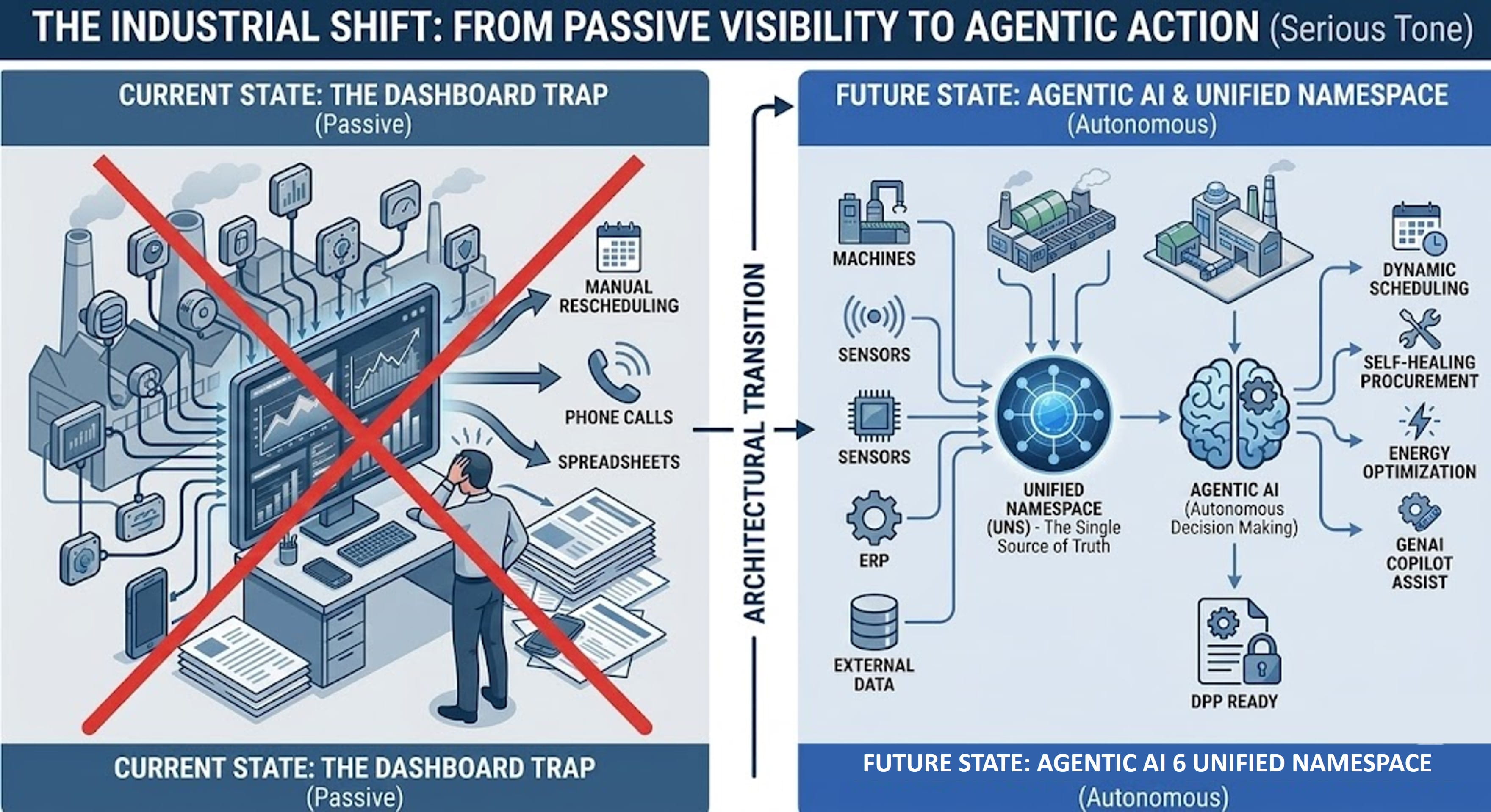
Most AI pilots fail to scale because they’re built on a “spaghetti architecture” of point-to-point integrations. A Unified Namespace (UNS) flips the model: data becomes a real-time product published once and consumed everywhere.
| The Old Way (tightly coupled) | The UNS Way (decoupled) |
|---|---|
| ERP asks SCADA, SCADA asks PLCs, PLCs ask sensors. Integrations are brittle, slow, and siloed. | Devices and apps publish to a central real-time broker. Consumers subscribe to what they need. Context travels with the data. |
| AI waits on batch pulls, inconsistent schemas, and “who owns this tag?” debates. | AI operates on a single source of truth with consistent names, timestamps, and operational context. |
From “Optimization” to Agentic AI
Predictive maintenance answered “What will happen?” Agentic AI answers “What should we do—and can we do it safely, now?” An industrial AI agent is an autonomous software module given a goal (e.g., maintain OEE above 85%) and the authority to act within guardrails.
Dynamic scheduling
The agent doesn’t just flag a fault—it reroutes production to alternate capacity and updates scheduling systems.
Self-healing procurement
If failure probability rises, the agent checks spares and drafts a PO for approval before the outage becomes urgent.
Energy modulation
During peak tariffs, the agent can throttle non-critical loads to keep costs within budget while protecting constraints.
Passive prediction → agentic action requires two prerequisites: (1) a real-time, contextual data layer (UNS), and (2) explicit guardrails defining what the agent may do automatically vs. what must be approved.
The GenAI Copilot: Scaling Expertise Across a Shrinking Talent Pool
The skills crisis is real: senior engineers retire, and junior technicians don’t have decades of intuition. GenAI belongs in the stack not as a controller of machines, but as a human accelerator—turning tribal knowledge into step-by-step guidance.
Example: A maintenance copilot on a tablet
Tech: “Unit 4 is throwing error code #992. What do I do?”
Copilot: “#992 typically indicates hydraulic pressure drop. Based on recent occurrences, check the relief valve.
Here’s the SOP, and here’s a prior fix walkthrough from last year.”
DPP & EU Compliance: Making Traceability a Byproduct of Good Architecture
For manufacturers selling into Europe, Digital Product Passports (DPP) are shifting from “future requirement” to operational reality. The strategic trap is treating compliance like paperwork. The better approach: design the data architecture so traceability happens automatically.
The trap
Manual reconciliation across MES/ERP/quality systems, late-stage data hunting, and inconsistent product lineage.
The solution
A UNS that tags production events to a product ID in real time—so the “passport” is effectively filled as the product is made.
A Practical ROI Model: From Alerts to Outcomes
The value of Agentic AI isn’t that it “predicts better.” The value is that it reduces the coordination cost and latency between detection and resolution—where downtime, scrap, and expedite costs accumulate.
- Baseline: downtime hours, scrap %, expedite fees, maintenance overtime, reschedule effort.
- Latency metric: time from alert → decision → action (before vs. after).
- Attribution: count interventions where the agent recommended or executed a change inside guardrails.
- Hard-dollar conversion: (hours avoided × cost/hour) + (scrap avoided × unit cost) + (expedites avoided).
The 2026 Playbook: How to Deploy UNS + Agentic AI Without Creating Technical Debt
Moving beyond dashboards is a sequencing problem. The winning approach builds a reliable real-time data backbone first, then introduces agents with explicit authority boundaries, then adds copilots to scale decision support.
Step 1: Establish the UNS “contract”
- Define the naming standard (assets, lines, products, states, alarms).
- Publish operational context (unit, timestamp, quality flags, lineage keys).
- Start with high-value streams (critical assets, bottleneck lines, energy meters).
Step 2: Promote data to “decision-grade”
- Harden time sync, data quality checks, and exception handling.
- Establish ownership for each data product (who publishes, who validates).
- Document the semantics once—reuse everywhere.
Step 3: Introduce agents with guardrails
- Start with “recommend only” (approval required), then expand autonomy.
- Codify constraints: safety, quality limits, capacity, changeover rules.
- Log every decision and provide explainability for auditability.
Step 4: Add the GenAI copilot layer
- Index SOPs, maintenance history, manuals, and prior work orders.
- Deliver guided troubleshooting for junior staff (human-in-the-loop).
- Capture feedback loops to improve procedures and recommendations.
Diagnostic Questions for Leaders
The best time to invest in AI infrastructure was yesterday. The second-best time is today—but only if the architecture is sound. If you’re scaling beyond isolated pilots, align the organization around these questions:
- Architecture: Are we building point-to-point integrations, or have we deployed a Unified Namespace?
- Agency: Does our system only alert us, or can it suggest and execute solutions within guardrails?
- Interface: Are we using GenAI copilots to capture tribal knowledge and guide junior staff?
- Compliance: Is our data architecture ready to automate Digital Product Passport creation?
Future-ready factories don’t just survive disruptions—they absorb them. They predict, prevent, and optimize autonomously, backed by robust architecture rather than hype.
Enhanced Full Blog Text (Board-Ready Report Format)
Executive perspective: In 2026, many manufacturers face a paradox: they have never had more operational visibility, yet they still struggle to translate insights into timely, coordinated action. The next wave of industrial transformation is defined by a shift from passive prediction to agentic execution, enabled by a real-time Unified Namespace (UNS) that provides a consistent, contextual single source of truth.
In 2026, the average smart factory is drowning in visibility but starving for action. For the last decade, manufacturers have raced to implement Predictive Maintenance (PdM). Assets were instrumented with IoT sensors, vibration data was piped into centralized platforms, and dashboards were built to flag rising risk conditions. The promise was straightforward: spot trouble early and avoid breakdowns.
That promise delivered value—to a point. However, the structural reality remains: knowing a machine will fail does not automatically fix the production schedule. A predictive alert is merely a high-tech thermometer. It indicates the patient is sick, but it does not provide a treatment plan. In a modern manufacturing ecosystem, a single maintenance event can ripple through energy management, logistics, quality control, and delivery timelines.
If a “smart” system still requires people to manually reshuffle the production deck every time a sensor spikes, the factory is not truly smart—it is simply operating with a faster alarm clock. The industry is now pivoting from passive prediction to agentic action. This is not a feature update; it is a fundamental architectural shift.
Before discussing AI, it is necessary to address the underlying plumbing. Many AI pilots fail to scale because they are built on a spaghetti architecture of point-to-point integrations. Each new integration increases fragility, latency, and operational overhead. In response, manufacturers are moving toward a Unified Namespace architecture.
Under the old approach, systems query one another in chains: ERP asks SCADA, SCADA asks PLCs, and PLCs ask sensors. The result is slow, brittle data exchange that creates silos. Under the UNS approach, every device and application publishes data to a central, real-time broker. Data is decoupled from any one consuming application.
This matters because an AI agent cannot make timely decisions if it must wait for batch updates or reconcile inconsistent schemas. The UNS provides the real-time, contextualized single source of truth that agentic systems require to function reliably.
Predictive Maintenance focused on answering: “What will happen?” Agentic AI focuses on answering: “What should I do about it, and can I do it myself?” An industrial AI agent is an autonomous software module that is given a goal—such as maintaining OEE above a threshold—and the authority to execute actions within defined safety and operational guardrails.
In practice, this can include dynamic scheduling (re-routing production when risk rises), self-healing procurement (checking spares and preparing purchase requests proactively), and energy modulation (throttling non-critical loads during peak tariffs). The critical point is that these actions are not isolated optimizations; they are coordinated decisions executed against shared, real-time context.
The skills crisis is accelerating. Senior engineers retire, and junior technicians lack decades of operational intuition. Generative AI is not positioned to control deterministic industrial processes; instead, its role is to empower humans with guidance and context. A maintenance copilot can interpret error codes, summarize likely causes based on history, and provide structured troubleshooting steps aligned to standard operating procedures.
This human-in-the-loop model turns junior staff into capable troubleshooters faster, capturing and reusing organizational knowledge rather than losing it to attrition.
For manufacturers selling in Europe, 2026 is the year Digital Product Passport expectations become operationally real. The EU demands granular traceability for market access. The common trap is to treat compliance as paperwork; the more resilient strategy is to treat it as a system design requirement.
A UNS-based architecture can tag production data to product identity in real time. When the product leaves the factory, the digital passport is already populated. Compliance becomes a byproduct of good architecture rather than a late-stage scramble.
The second-best time to invest in AI infrastructure is today—provided the strategy avoids creating technical debt. Leaders evaluating scale beyond pilots can use four questions to diagnose readiness: (1) Are we building point-to-point integrations or a Unified Namespace? (2) Do our systems only alert us, or can they suggest and execute actions within guardrails? (3) Are we using copilots to capture tribal knowledge and guide junior staff? (4) Is our data architecture ready to automate Digital Product Passport creation?
The factories that win in 2026 will be defined not by more dashboards, but by architectures that enable systems to predict, prevent, and optimize autonomously—with robustness over hype.
Miguel R (Plant Operations Manager) updated on 18 Jan 2026, 11:25AM
We’ve invested heavily in PdM, but the “thermometer vs treatment plan” line hits home. The rescheduling and coordination work is where we still lose hours. Curious how you recommend starting UNS without boiling the ocean?Crius Team updated on 18 Jan 2026, 01:40PM
Great question. The most reliable path is to start with one value stream: bottleneck assets + the systems that influence actions (maintenance, scheduling, inventory). Define naming + context contracts first, then publish those streams into the UNS so multiple consumers can reuse them. That sequencing prevents “one-off” integrations.Hannah L (Reliability Engineer) updated on 19 Jan 2026, 09:05AM
The guardrails point is critical. We tried an “auto” workflow and hit pushback because people didn’t trust the decision logic. The audit trail + explainability requirement should be non-negotiable.Ethan H updated on 19 Jan 2026, 10:22AM
Agreed. We see adoption accelerate when autonomy is staged: recommend-only → approve-and-execute → bounded autonomy for well-understood scenarios. Logs, approvals, and “why this action” summaries turn fear into confidence.Ranjith P (Manufacturing IT Lead) updated on 20 Jan 2026, 02:10PM
We’ve got ERP, MES, SCADA, historians—data is everywhere. The biggest friction is semantics: what one system calls “Line_2_Status” another calls “Ln2_Mode.” Any tips on governance that won’t slow delivery?Crius Admin updated on 20 Jan 2026, 03:05PM
Treat semantics as a product contract. Assign owners per domain (assets, quality, energy, scheduling). Start with a small canonical model for the pilot, then expand. Governance doesn’t have to be a committee—lightweight stewardship plus automated validation checks can keep velocity high.Carol S (Quality Manager) updated on 21 Jan 2026, 08:50AM
DPP is becoming real for us. I like the framing that compliance should be a byproduct. If we tag lineage at creation time, audits become easier and less disruptive.Dominic F updated on 21 Jan 2026, 11:30AM
Exactly. When product IDs and batch/lot context travel with events through the UNS, you stop reconstructing history after the fact. It also improves root-cause analysis when quality issues surface.Sarah K (Maintenance Supervisor) updated on 22 Jan 2026, 04:15PM
The GenAI copilot example is spot on. My senior techs are retiring and training time is painful. If a copilot can guide troubleshooting and standardize SOP usage, that alone could justify the program.Industrial Architecture Team updated on 22 Jan 2026, 05:05PM
That’s a common outcome. The key is grounding responses in your approved SOPs, work orders, and manuals—then capturing feedback from technicians so the copilot improves and stays aligned to plant reality.